Last-Mile Delivery Challenges and Costs: Why the Final Stop Is Expensive and How to Optimize It
A delivery route of only a few kilometers can still consume a surprising amount of time and resources. The vehicle may spend as much time waiting for loading, entering a facility, or completing handover procedures as it does moving between locations.
That is why last-mile delivery costs cannot be judged by mileage alone. For logistics operators, the more useful question is what the entire transportation task requires: how often it runs, how much driver time it consumes, how much cargo it carries, and how consistently the workflow can be executed.
Autonomous delivery vehicles can become relevant when these conditions are clear enough to support a reliable operating model. The opportunity is less about automating every delivery and more about identifying specific transportation tasks where automation can improve the economics of the operation.
Why Last-Mile Delivery Costs More Than Distance Suggests
The final stage of delivery involves much more than driving: a vehicle may need to queue at a distribution center, wait for goods to be prepared, complete loading checks, enter a controlled facility, find a designated unloading area, and wait again before returning. When the same movement is performed repeatedly, these small periods of non-driving time accumulate.
Driver labor is often tied to the entire task rather than the number of kilometers traveled. A driver assigned to a short transfer still has to remain available while the vehicle is being loaded, driven, unloaded, and prepared for its next trip. Vehicle utilization can also suffer when a large part of the working day is spent waiting rather than transporting useful cargo.
This creates an important distinction between distance traveled and resources consumed. A short route with frequent stops and long turnaround times can be more expensive than a longer route with a predictable loading process and continuous vehicle movement.
For operators looking at last-mile delivery optimization, the starting point should therefore be the operating cycle rather than mileage alone.
FairPrice: A Commercial Example
Zelostech's work with FairPrice provides a practical example of how a recurring logistics task can be structured for autonomous operation.
Z10 RoboVans transport goods within and between FairPrice distribution centers at Benoi, Joo Koon, and Sunview Road, with routes of up to 5.5 km. The pilot began in October 2024. The vehicles completed the pilot with zero takeovers and zero incidents, and LTA approved fully remote operations without a safety vehicle in April 2025.
In October 2025, Zelostech became the first autonomous logistics company approved by LTA for remotely supervised driverless vehicles on public roads for supply-chain logistics. The deployment involved nearly 30 Z10 vehicles, transporting goods such as palletized products, fruits, and daily essentials.
The significance of this example is the structure of the task. The vehicles operate within an established distribution network, connecting known facilities and supporting a recurring logistics workflow. The route itself is only one part of the operating model; the surrounding processes make the task suitable for autonomous operation.
That distinction matters when evaluating other logistics applications. A vehicle does not become commercially useful simply because it can drive without a driver. The transportation task has to make operational and economic sense as a whole.
How to Identify a Suitable Logistics Task
Before considering automation, operators can start with the transportation work already taking place inside their network.
The first step is to measure how often a task runs and how much human time it consumes. A transfer that takes place several times a day may deserve closer attention than a similar route used only occasionally. The relevant figures include driving time, loading and unloading time, waiting time, and the time a driver must remain assigned to the vehicle.
Cargo requirements should be measured at the same time. Payload, cargo volume, loading method, and delivery frequency determine whether a vehicle can handle the task efficiently. A route that appears attractive on mileage may be less suitable if cargo preparation is inconsistent or loading requires extensive manual intervention.
The physical environment also matters. Operators need to consider road access, facility entrances and exits, traffic conditions, intersections, parking or staging areas, and how the vehicle interacts with people and other vehicles. Regulatory requirements and the approved operating area must also be part of the assessment.
This evaluation can reveal a useful difference between two seemingly similar routes. A short public-road delivery with unpredictable stops may be difficult to automate, while a longer transfer between two facilities with fixed loading points and consistent operating procedures may provide a better starting point.
The final comparison should include the costs of the proposed autonomous operation, including fleet supervision, maintenance, charging, insurance, infrastructure, and compliance. The objective is to compare the economics of the complete operating model, rather than assuming that removing a driver automatically removes the associated cost.
Where RoboVans Fit into Logistics Operations
Once a suitable transportation task has been identified, the next question is vehicle fit.
RoboVans can support several types of recurring logistics work where cargo movement follows an established workflow. These include retail replenishment, postal and express logistics, warehouse transfers, industrial and business park operations, airport logistics, and cold-chain distribution.
Zelostech's application portfolio covers environments such as postal delivery, grocery and food delivery, retail replenishment, campus delivery, warehouse transfer, industrial park logistics, production-line delivery, airport logistics, and cold-chain distribution. These applications share an important characteristic: the transportation task can be defined clearly enough for its operating requirements to be assessed before deployment.
Vehicle specifications then need to match the actual task.
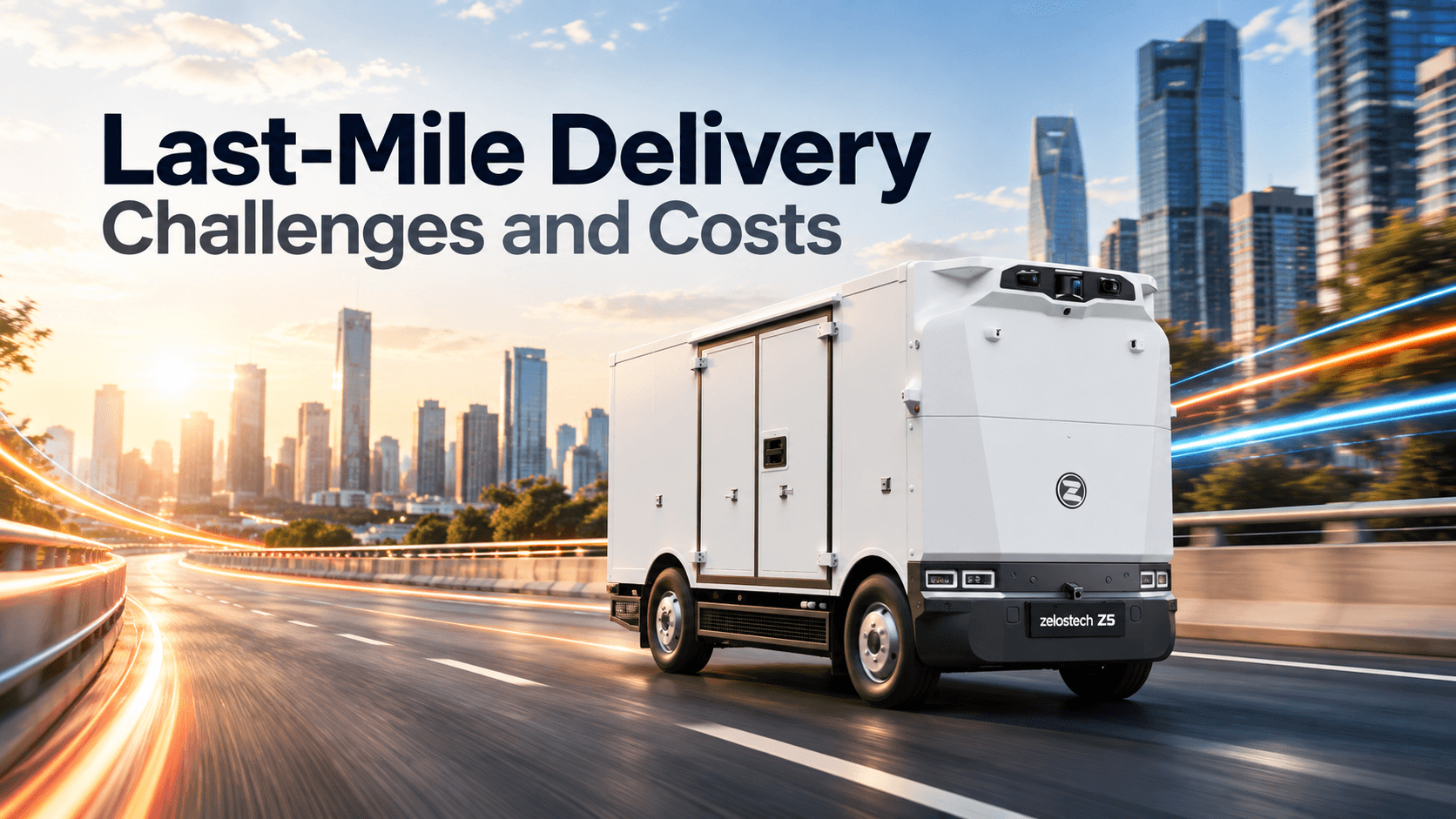
The Z5 RoboVan provides up to 230 km of range, a maximum load of 1,800 kg, and 6.2 m³ of cargo space. For temperature-controlled logistics, the Z5 Cold-Chain version provides up to 180 km of range, a maximum load of 1,555 kg, and temperature control from -20°C to 12°C.
This task-first approach also applies when logistics operations expand beyond traditional delivery routes.
In August 2026, Zelostech and F&N announced a strategic deployment agreement for Z10 RoboVans in mixed-traffic warehouse environments. The deployment addresses operational issues including driver shortages, rising logistics costs, and efficiency bottlenecks.
The example illustrates how autonomous logistics can extend into internal transportation workflows rather than being limited to the final movement to a customer. Warehouse transfers, facility-to-facility movements, and other repetitive cargo tasks can become potential applications when their operating conditions and requirements are sufficiently well defined.
Summary
Last-mile delivery costs are shaped by the time and resources required to complete a transportation task, not just by the number of kilometers traveled.
For logistics operators, a practical starting point is to identify recurring movements that consume significant driver time and vehicle capacity, then evaluate the cargo requirements, physical environment, operating procedures, and regulatory conditions. Only after that assessment does it make sense to determine whether an autonomous vehicle can improve the economics of the task.
FairPrice demonstrates how this approach can work in commercial supply-chain operations, while Zelostech's applications in warehouse, industrial, postal, retail, and cold-chain environments show where similar opportunities may exist.
The key question is whether the transportation task consumes resources that could be used more efficiently, and whether a RoboVan can perform that task reliably within the required operating environment.