Automation and Human Judgment
April 28, 2026
Share this article:
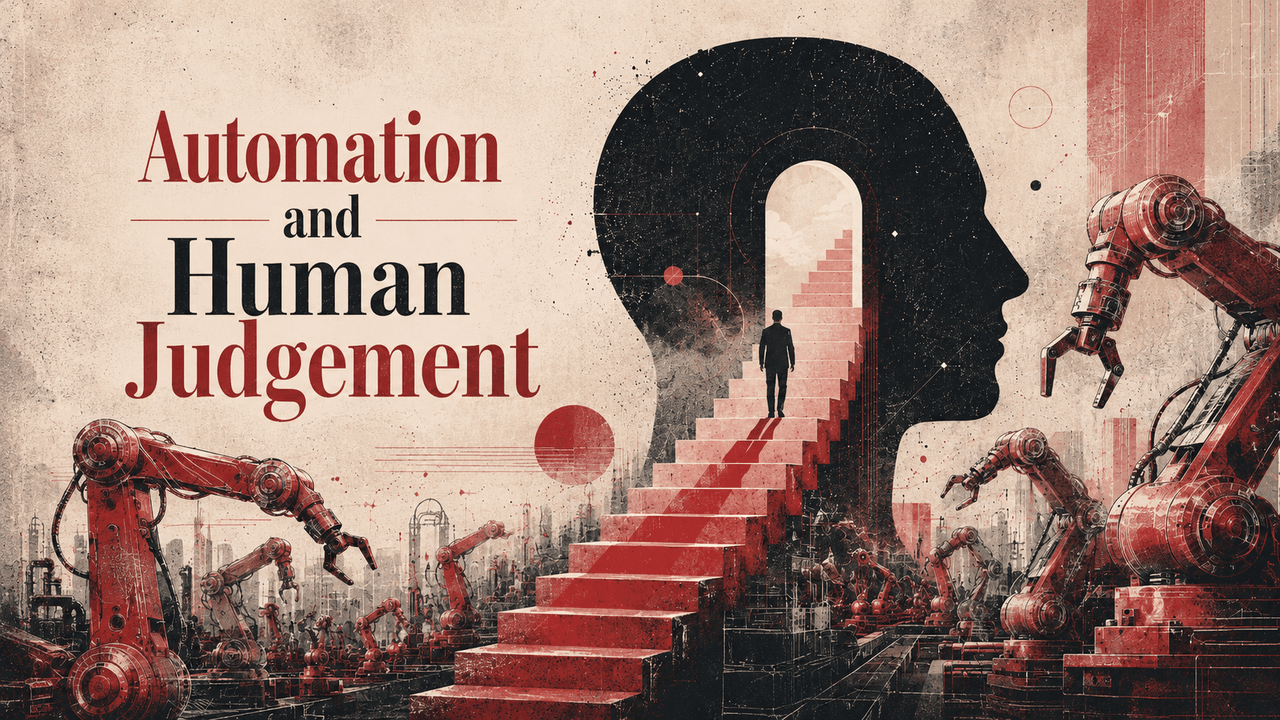
Systems that once depended entirely on human action are increasingly shaped by automation. Tasks that follow clear patterns, repeat at scale, or rely on stable inputs are now performed with a level of consistency that human labor cannot easily sustain. This shift is visible across industries, from manufacturing to logistics to digital services. It reflects a broader movement toward systems that can operate with greater regularity, extending capacity without requiring proportional increases in human effort.
Yet the expansion of automation does not resolve the question of judgment. It clarifies it. As more structured tasks are absorbed into automated systems, the boundary between what can be formalized and what must still be interpreted becomes more visible. The question is no longer whether machines can perform certain functions, but where the limits of that performance lie.
The Expansion of Automation
Automation advances most effectively in environments where patterns are stable and outcomes can be defined in advance. Repetition allows systems to refine performance over time, reducing variability and improving efficiency. In such contexts, automation does not simply replace human effort. It reorganizes it, shifting labor away from direct execution toward the design and management of systems.
This process is cumulative. As systems improve, they take on more of the structured tasks that once required attention. The result is not the disappearance of work, but its gradual movement into different forms. Human involvement becomes less visible in the act itself and more present in the conditions that make the act possible.
The Limits of Formalization
Not all forms of decision-making can be reduced to rules or data. Real environments contain ambiguity, incomplete information, and conditions that resist clear categorization. Systems trained on prior patterns can respond effectively within known ranges, but they encounter limits when faced with situations that fall outside established structures.
These limits are not failures of technology, but reflections of the complexity of the world itself. Formalization depends on the ability to define conditions in advance. Where such definition becomes difficult, interpretation becomes necessary. This marks the point at which human judgment retains its role, not as a fallback, but as a distinct mode of engagement with uncertainty.
Judgment Under Uncertainty
Human judgment operates in spaces where information is partial and outcomes are not fully predictable. It draws on context, experience, and the ability to weigh competing factors that may not be directly comparable. In such situations, decision-making is less about optimization and more about navigation, finding a course through conditions that cannot be fully specified.
This capacity does not diminish as systems become more advanced. It becomes more concentrated. As automation handles structured decisions, human attention shifts toward the moments that require interpretation. These moments are fewer in number but greater in consequence, often involving safety, ethical considerations, or unexpected system behavior.
This shift also carries a dimension of responsibility. Automated systems can extend capability, but they do not remove accountability. The interpretation of outcomes, the response to failure, and the ethical framing of system behavior remain human concerns. The presence of automation does not diminish the importance of human judgment, it places it in a more focused and visible position.
A Balanced System
The relationship between automation and human judgment is not one of replacement, but of distribution. Each operates within different domains, shaped by the nature of the tasks they address. Systems excel where structure is clear and repetition is possible. Human judgment remains essential where conditions are uncertain and meaning must be interpreted.
The future of work will likely reflect this balance. Automation will continue to extend the range of what can be systematized, while human roles will increasingly center on oversight, coordination, and responsibility. The challenge is not to separate these functions, but to integrate them in ways that preserve both efficiency and judgment.
In this integration, automation becomes part of the ongoing evolution of work. It reshapes how effort is applied, but does not remove the need for human presence within complex systems. What remains is not a diminished role for people, but a more defined one, grounded in the capacities that cannot be easily reduced to code.