Automation and the Evolution of Work
April 14, 2026
Share this article:
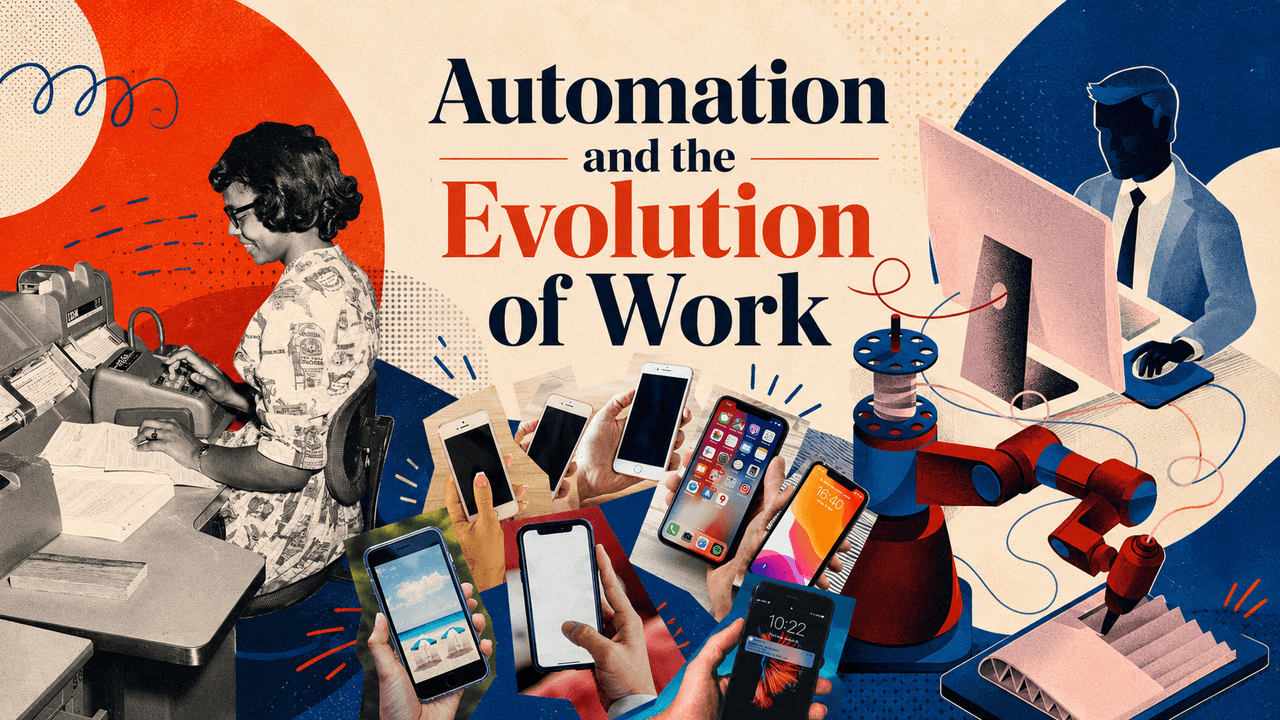
Work has always evolved alongside the tools that shape production. Each major technological shift has reconfigured the structure of labor, altering how time, effort, and productivity are brought into relation. From the mechanization of early industry to the computational systems of the digital age, new technologies have repeatedly redefined what human effort is directed toward. The history of labor is therefore not a story of disappearance, but of transformation, where old tasks recede and new forms of coordination, oversight, and expertise emerge in their place.
What makes the current era distinct is the speed at which intelligence is beginning to enter operational systems once governed entirely by human judgment. Automation now touches forms of work long considered too variable, too physical, or too context-dependent to be systematized. This has understandably raised broader concerns about displacement. Yet history suggests that the deeper question is not whether work will continue, but how the structure of work changes when repetitive decision-making and routine movement begin to shift into the domain of machines.
Historical Perspective
Past industrial transformations offer a useful lens through which to view the present. Mechanization did not eliminate labor during the first industrial revolution. It reorganized it, moving human effort away from raw physical repetition and toward supervision, coordination, and higher-value craft. The assembly line similarly transformed manufacturing work, creating new roles in system management, maintenance, logistics, and quality control. Later, computing altered clerical and analytical work, reducing manual processing while expanding entirely new fields of technical and managerial expertise.
What remains consistent across these transitions is that productivity gains rarely remove the need for labor itself. Instead, they change the kinds of labor societies require. New technologies increase the productive capacity of systems, which in turn expands the scale and complexity of the work that surrounds them. Labor evolves alongside infrastructure.
The Logistics Workforce Challenge
This historical perspective becomes especially relevant in logistics, where structural workforce pressures are already visible. Many logistics systems face persistent labor shortages, particularly in roles defined by long hours, repetitive routes, and physically demanding conditions. In some regions, aging workforces have further intensified these pressures, raising questions about long-term continuity in essential movement systems.
Safety also remains a central concern. Urban delivery and transport work often place individuals in environments shaped by traffic density, fatigue, time pressure, and repeated exposure to risk. These pressures are not incidental, but built into the ordinary conditions of movement work within modern cities. As demand for logistics continues to rise, these strains become harder to absorb through labor expansion alone.
Automation as Augmentation
Seen in this context, automation is best understood as augmentation rather than substitution. Its most immediate value lies in absorbing forms of repetitive movement and routine operational judgment that place sustained strain on workers. By taking on highly repetitive routes, maintaining consistent performance across long operating windows, and reducing exposure to hazardous conditions, autonomous systems can shift the human role toward supervision, exception handling, systems coordination, and higher-level operational planning.
This changes the quality of work as much as its distribution. Human labor moves closer to oversight, maintenance, fleet orchestration, safety assurance, and the interpretation of system behavior. The result is a working environment less centered on physical exhaustion and more oriented around technical stewardship of increasingly intelligent systems.
A Broader View of Productivity
Productivity should therefore be understood in broader social terms. It is not simply the acceleration of output, but the capacity of a society to allocate human effort toward forms of work that create greater resilience, safety, and long-term value. When repetitive tasks are absorbed by automation, labor can be redirected toward the layers of coordination and judgment that complex systems increasingly require.
These transitionary periods reshape the production of surplus labor, as technological systems compress necessary labor time and expand the social capacity for value creation, making the political question of how that surplus is distributed increasingly important. Automation extends the productive capacity of logistics systems while creating demand for new forms of technical and managerial expertise.
Automation should be understood as part of the historical development of labor, not as an outside disruption to it. From a teleological perspective, automation may be recognized as the historical movement of labor toward forms of work less bound by repetition and more oriented toward human flourishing.
The question is not whether automation changes work, but how societies choose to guide its transition. Like every technological shift before it, automation changes the texture of labor. What matters is whether that transition leads to work that is safer, more sustainable, and more aligned with the needs of the systems we now depend on. Technological innovation is an inevitable force in human development; the real question is whether societies and governments will guide it in ways that expand human flourishing, strengthen dignity in work, and secure a better quality of life for future generations.