Autonomous Delivery Vehicle Laws Across Key US States
An autonomous delivery route can look commercially attractive before anyone checks which legal category the vehicle occupies. A road vehicle carrying freight, a low-speed delivery vehicle and a small sidewalk robot may face different rules in the same state. The first regulatory decision is to identify the intended vehicle and operating environment precisely.
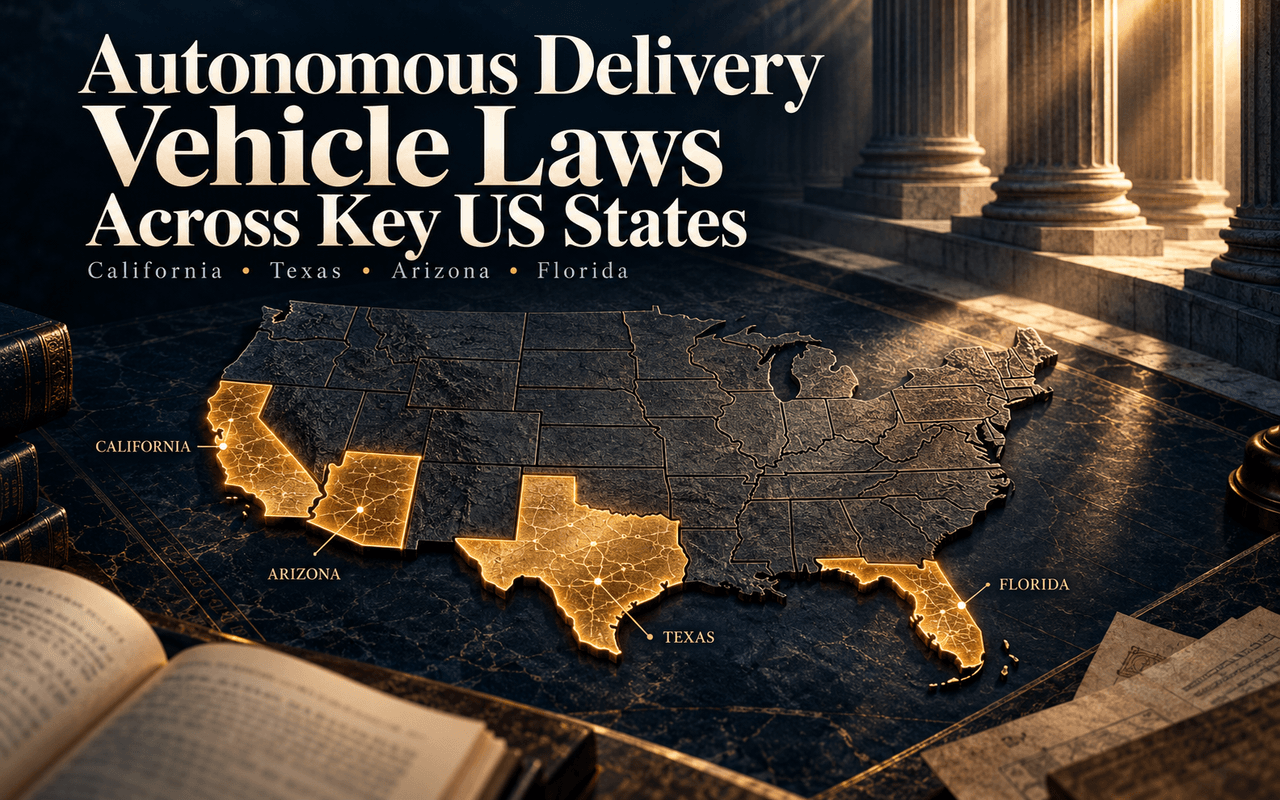
This comparison covers four representative states: California, Texas, Arizona and Florida. It focuses on road-based autonomous delivery, with the law and official guidance checked in October 2026. These states illustrate different approaches to permission, documentation and oversight; they do not represent a complete survey of all 50 states or a substitute for checking a proposed route.
Federal vehicle requirements remain part of the decision
State operating permission does not settle federal vehicle compliance. A purpose-built vehicle must address applicable Federal Motor Vehicle Safety Standards or the relevant exemption route. In its July 2026 policy announcement, NHTSA described continuing work on standards and exemptions, including review of a low-speed autonomous vehicle application from Robomart. Review of an application should not be described as approval.
For a logistics buyer, this creates two linked workstreams: establish the vehicle’s federal basis and verify the state operating pathway. Evidence should identify the actual vehicle configuration, intended use and any conditions attached to an exemption. A general statement that a state welcomes autonomous vehicles does not answer those questions.
California requires a staged permitting approach
California’s April 2026 regulatory update strengthens oversight and describes progression through safety-driver testing, driverless testing and deployment. It also introduces enhanced safety-case, remote-operations and reporting requirements. Because provisions have different implementation dates, applicants should consult the current regulatory documents for the obligations applicable to their stage.
The update includes closer coordination with emergency responders and mechanisms for restricting operations when safety concerns arise. For a delivery fleet, the operational implication is concrete: dispatch systems and support staff must be able to respond when an area becomes unavailable. A parcel deadline cannot override a restriction imposed for an emergency.
California’s April 2026 rules also opened testing and deployment pathways for heavy-duty autonomous vehicles with a GVWR of 10,001 pounds or more, removing a major previous restriction on autonomous freight operations.
Texas now requires commercial operating authorisation
Texas introduced a material change through Senate Bill 2807 and implementing rules. According to the TxDMV Automated Vehicles Regulatory Program, the authorisation requirement became enforceable on 28 May 2026. The programme covers commercial transportation of property or passengers without a human driver using the relevant automated vehicles.
An applicant must make specified acknowledgements covering matters such as traffic-law compliance, recording equipment, federal compliance, registration and the ability to reach a minimal-risk condition following a qualifying system failure. Emergency-response arrangements also form part of the regulatory process. Describing Texas as a state where commercial driverless fleets need no authorisation would now be misleading.
For a warehouse operator, the procurement consequence is straightforward: verify the operating entity’s current authorisation before agreeing a launch date. Assign responsibility for keeping the authorisation and associated records current, particularly when the technology provider and transport operator are different businesses.
Arizona centres its process on operating documentation
Arizona’s guidance for operation without a driver requires a law-enforcement interaction plan and a written statement addressing defined conditions. These include applicable federal requirements or exemptions, a minimal-risk response to failure, traffic-law compliance and relevant registration and insurance obligations.
This documentary approach still creates practical duties. A delivery fleet needs usable contact arrangements and a clear response when police encounter an unattended vehicle. Those arrangements should be rehearsed with the people who will answer the call. Filing a plan provides little operational value if the support team cannot identify the vehicle, understand its condition or arrange recovery promptly.
Florida permits driverless operation subject to applicable conditions
Florida Statutes section 316.85 allows a qualifying fully autonomous vehicle to operate without a human operator physically present and addresses compliance with traffic and motor-vehicle laws. Operators must still establish the applicable vehicle classification and related obligations; sidewalk delivery devices should not be assumed to follow the same provisions.
Legislative proposals require particular care. Florida SB 1258 proposed requiring an onboard licensed human for certain commercial deliveries, but the official bill record shows that it died in committee on 13 March 2026. Its proposed July effective date did not make that restriction law. Checking legislative status prevents an abandoned proposal from distorting a market-entry decision.
Comparing the operating burden behind the legal pathway
These differences affect staffing and service design. California’s staged process, Texas’s commercial authorisation and Arizona’s required documentation each demand a clear allocation of responsibility. Florida’s statutory permission still leaves the operator to establish that the proposed vehicle and service satisfy the relevant conditions. The comparison should lead to a route-specific operating plan, with evidence attached to each responsibility.
An overseas example helps explain the logistics work behind such a plan. Singapore-based company Zelostech reported deployment and validation with SATS at Changi Airfreight Centre in September 2026. The activity connects SATS cargo terminals with freight-forwarder warehouses within the Free Trade Zone, initially handling loads of up to 800 kilograms.
The relevance is the transfer task: cargo must reach the correct receiving point within a working freight network. The Singapore project provides an operational reference for the logistics questions a US deployment would still need to answer: who releases the cargo, who receives it, and what happens when a vehicle cannot complete the trip as planned.
Selecting a state through the proposed service
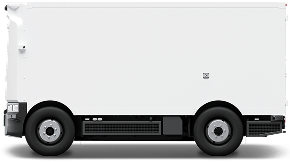
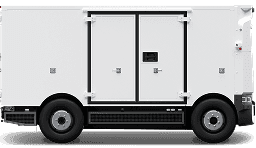
Businesses considering a RoboVan logistics platform should compare the intended route against the applicable legal pathway before evaluating fleet size. A short depot connection may have a different approval and support burden from a dispersed delivery service. The relevant logistics application should determine the vehicle category, operating hours and handover model.
For logistics operators, the most useful state comparison starts with the proposed service rather than a general ranking of AV-friendly jurisdictions. Vehicle classification, operating authorization, federal compliance, recovery arrangements and route conditions all affect whether a driverless delivery service can launch reliably. Those requirements should be assessed alongside journey frequency, handling time and fleet economics before a state is selected for deployment