Modern logistics has become one of the defining pressures of urban life. Goods move through cities with a speed and frequency that would have been difficult to imagine a generation ago. A package ordered in the morning may arrive by evening. Retail shelves are replenished before shortages become visible. Restaurants, pharmacies, factories, and residential communities all depend on a continuous rhythm of movement that rarely announces itself unless it fails.
This convenience has changed expectations. Speed is no longer treated as exceptional. Reliability is assumed. The city has become a place where goods must circulate almost constantly, across streets that were not designed for this level of logistical intensity. What appears effortless at the point of delivery is sustained by a system under increasing strain.
The Pressure Beneath Modern Logistics
The growth of e-commerce, on-demand services, and distributed supply chains has reshaped how goods move. Traditional logistics was often organized around scheduled routes, centralized warehouses, and predictable volumes. Today, movement is more fragmented. Deliveries are smaller, more frequent, and spread across longer operating windows.
This creates pressure in several directions at once. Roads become more crowded. Delivery vehicles repeat overlapping routes. Curb space becomes harder to manage. Operators face rising costs while customers expect faster service. The system is asked to become more responsive, yet the structure beneath it often remains limited by older patterns of coordination.
The result is a quiet mismatch between demand and infrastructure. Cities need logistics to function, but the systems responsible for that movement are carrying more complexity than ever before.
The Safety Question
Logistics is not only a question of efficiency. It is also a question of safety.
Urban delivery takes place in environments shaped by traffic density, pedestrians, cyclists, irregular parking, time pressure, and repeated stop-and-go movement. These conditions create risk for drivers, road users, and the wider urban environment. Even when incidents are rare, the exposure is continuous. The more movement a city requires, the more important consistency becomes.
Human drivers remain essential across today’s logistics networks, but they operate under constraints that cannot be ignored. Fatigue, distraction, weather, and schedule pressure all affect performance. In repetitive transport tasks, especially across fixed or frequent routes, the challenge is not only skill. It is the difficulty of sustaining attention and precision over long periods of time.
This is one of the areas where autonomous logistics begins to matter. Properly developed, tested, and deployed, autonomous systems can bring a higher degree of consistency to repetitive movement. They do not remove the need for human oversight. They change where human judgment is applied, shifting it toward monitoring, coordination, exception handling, and system management.
The Manpower Challenge
Logistics also faces a labor challenge. In many markets, delivery and transport roles are becoming harder to fill, especially where work is repetitive, physically demanding, or exposed to long hours on the road. As populations age and expectations for delivery speed continue to rise, relying only on expanding the human workforce becomes increasingly difficult.
This does not mean that automation should be understood as a simple replacement for labor. That framing is too narrow. The deeper issue is how essential systems continue to operate when demand grows faster than available manpower.
Autonomous logistics can help absorb repetitive transport tasks that place pressure on the workforce. This allows people to move toward higher-value roles in fleet supervision, maintenance, dispatch, safety management, customer operations, and technical support. Work does not disappear. It changes form around a more advanced infrastructure.
The Sustainability Burden
Every movement of goods carries an energy cost. When routes overlap, vehicles idle, cargo space is underused, or trips are poorly coordinated, that cost grows. At the scale of a city, small inefficiencies become structural. They appear as congestion, emissions, wasted energy, and unnecessary strain on roads.
Sustainability in logistics cannot depend only on cleaner vehicles. Electrification matters, but a clean vehicle used inefficiently still consumes more energy than necessary. The larger question is how movement is organized.
More intelligent logistics systems can reduce unnecessary circulation. They can improve route planning, increase utilization, and support more stable operation across complex environments. Sustainability begins to move beyond the vehicle itself and into the logic of the system. The goal is not simply to power movement differently, but to reduce the waste built into movement.
Where Zelostech Fits
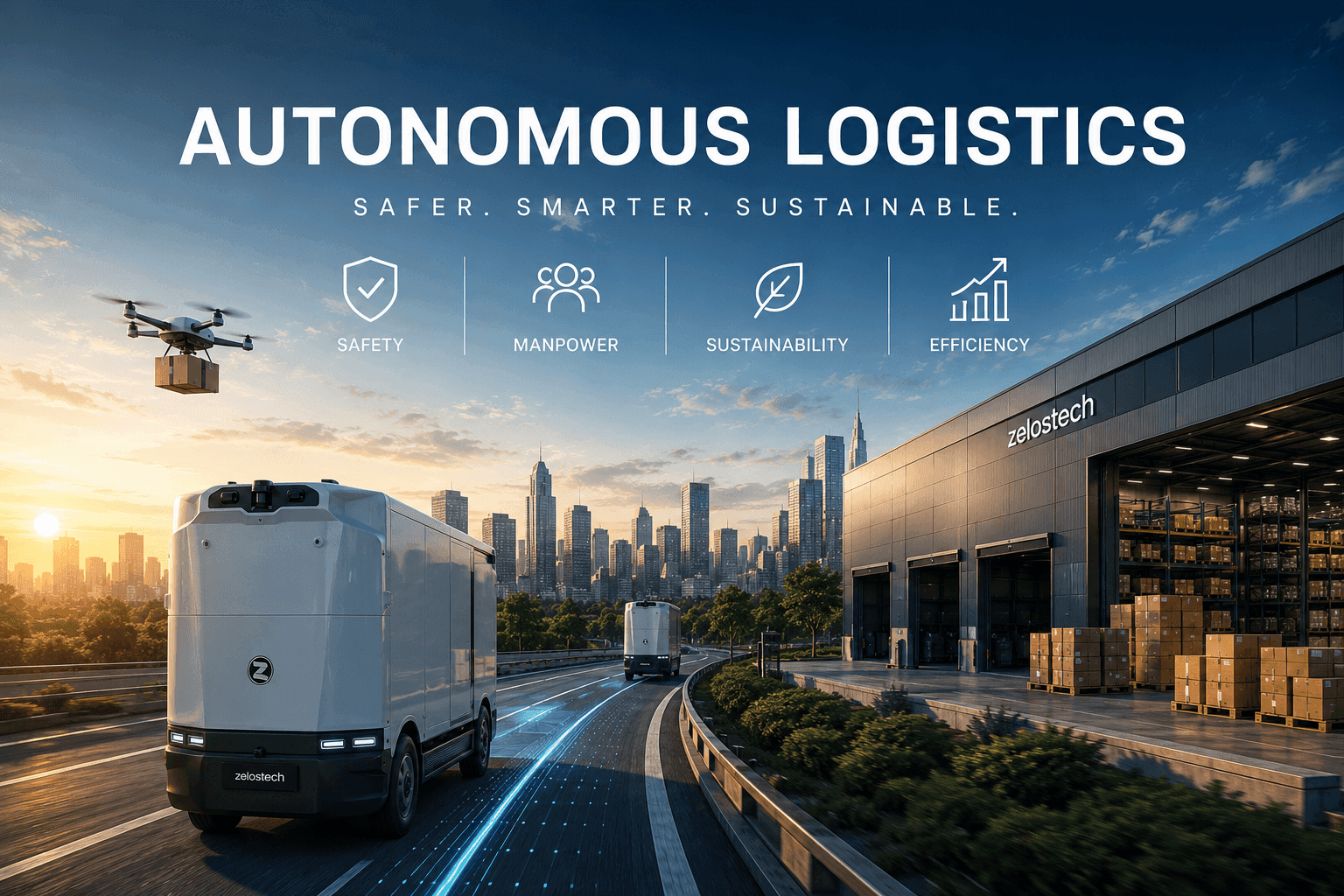
At Zelostech, we see autonomous logistics as part of a broader evolution in urban and industrial infrastructure. Our work is not centered on autonomy as a concept, but on the practical demands of real logistics environments: safety, reliability, efficiency, sustainability, and scalable deployment.
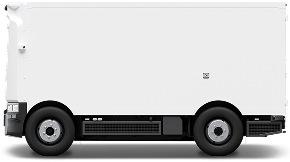
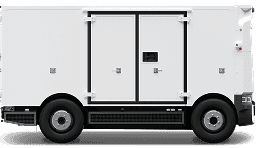
Our autonomous vehicle platform is designed for the places where goods actually move. This includes urban delivery, industrial parks, business campuses, retail replenishment, pharmaceutical logistics, cold-chain operations, intralogistics, and other scenarios where repetitive movement is essential to daily operations.
These environments require more than a vehicle. They require a system capable of operating with consistency across changing conditions. They require perception, planning, control, fleet coordination, energy management, and operational reliability. Autonomous logistics becomes valuable when these elements work together as infrastructure.
From Vehicles to Logistics Infrastructure
The future of logistics will not be defined by isolated machines. It will be defined by coordinated systems.
A single autonomous vehicle can improve a route. A fleet can reshape how movement is organized across a site, district, or city. As these systems mature, they can help reduce pressure on labor, improve safety in repetitive operations, support lower-carbon movement, and increase the efficiency of delivery networks.
This is the direction Zelostech is working toward. We believe autonomous logistics should make movement more dependable, more sustainable, and easier to manage at scale. In practical terms, that means helping customers move goods with less friction and fewer operational constraints.
The Next Layer of Urban Movement
Every era of logistics has been shaped by the infrastructure available to it. Railways expanded industrial economies. Highways transformed regional distribution. Containerization reorganized global trade. Today, intelligent autonomous systems are beginning to form the next layer of movement infrastructure.
The pressures facing logistics are not temporary. Cities will continue to grow. Delivery expectations will continue to rise. Industrial operations will continue to require safer and more efficient movement. The question is whether the systems that support this movement can evolve quickly enough.
Autonomous logistics offers one path forward. It does not solve every challenge on its own, and it should not be presented as a cure for all complexity. Its value lies in addressing specific structural pressures that modern logistics can no longer ignore: accidents, manpower constraints, emissions, operational inefficiency, and the growing difficulty of coordinating movement at scale.
At Zelostech, our purpose is to build autonomous systems that meet these realities directly. The future of logistics will depend on moving goods not only faster, but with greater intelligence, consistency, and care.