Autonomous Vehicles in Logistics: Benefits, Safety, Challenges, Economic Impact, and the Path to Large-Scale Adoption
For decades, urban logistics has relied on a simple formula: add more delivery vehicles, hire more drivers, and expand operations as demand grows. That model worked when enough drivers were available and delivery networks could absorb fluctuations in demand. Today, however, the economics of last-mile logistics are rapidly changing.
Across the logistics industry, companies are being asked to deliver more shipments with fewer available workers. Driver shortages have become a long-term workforce issue rather than a temporary hiring challenge. At the same time, transportation costs continue to rise, customers expect shorter delivery windows, and regulators are placing greater emphasis on road safety, emissions, and operational compliance. These pressures explain why autonomous logistics vehicles are becoming important to the future of logistics.
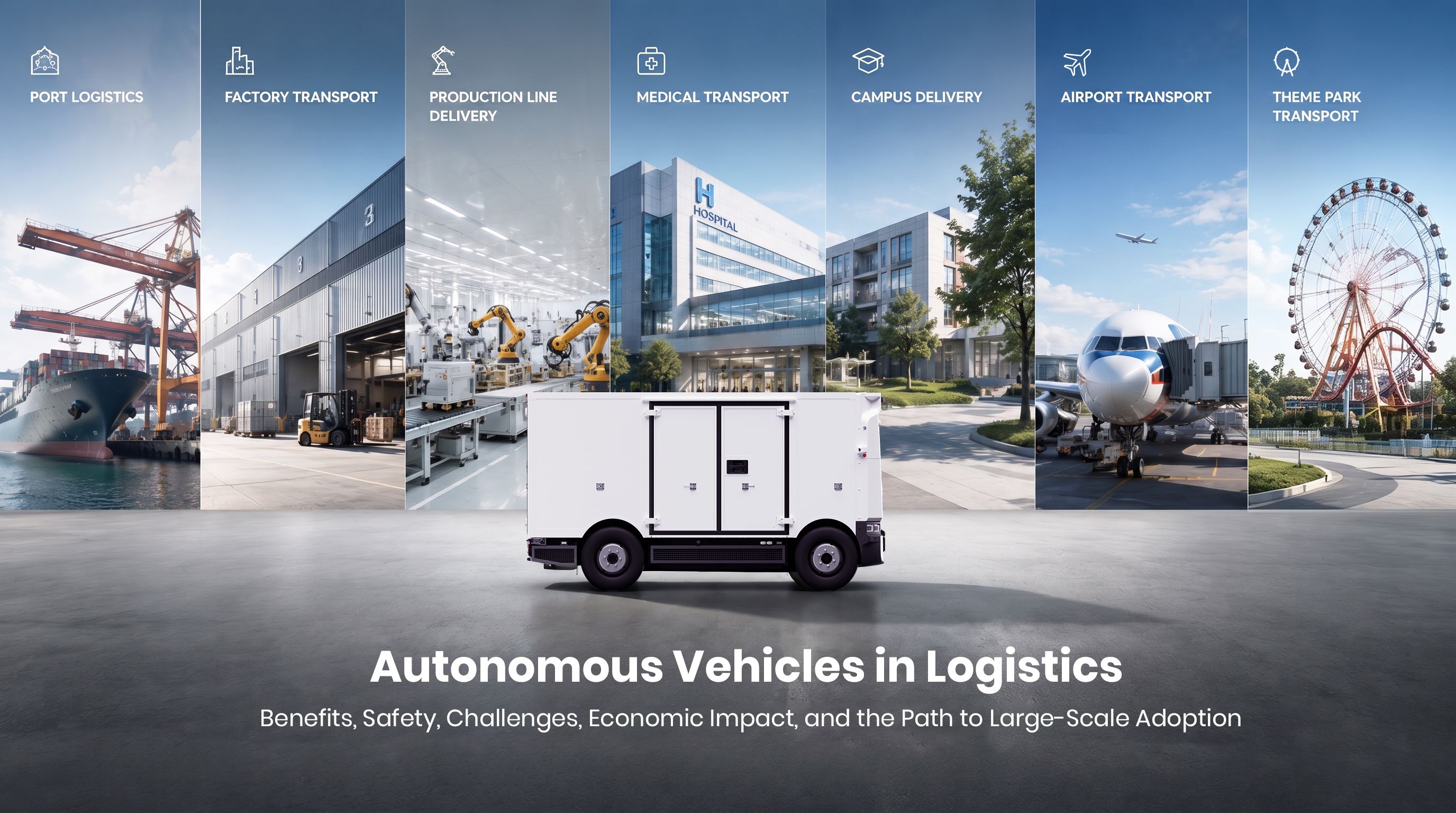
Autonomous logistics vehicles have already moved beyond the research stage and into selected commercial operations. They support applications such as airport logistics, industrial park operations, campus transportation, postal services, port logistics, and last-mile delivery routes where operating conditions can be managed more effectively.
Even so, autonomous vehicles cannot replace every commercial vehicle on public roads, nor are they expected to eliminate the need for professional drivers in the foreseeable future. Why? Logistics involves far more than steering a vehicle. Drivers need to inspect cargo, communicate with customers, coordinate loading and unloading, and respond to unexpected situations.
That is why, instead of asking whether autonomous vehicles can work, logistics companies are more concerned about the practical question of whether autonomous vehicles can create measurable operational value and expand to large-scale deployment.
The reality is more nuanced. Autonomous vehicles offer significant opportunities, but they also come with technical and operational limitations. This article examines why autonomous vehicles are important, what the challenges are, the economic impact, and the infrastructure requirements.
Why are autonomous vehicles important for modern logistics?
Advances in autonomous driving technology have made commercial deployment practical in controlled logistics environments. Autonomous vehicles can now operate not only in semi-closed environments, such as warehouses, airports, industrial parks, ports, and campuses, but also on selected public roads.
This explains why interest in autonomous logistics has grown so quickly. In addition, driver shortages, safety concerns, rising operational costs, and the need for more resilient logistics networks are accelerating interest in autonomous solutions.
Driver shortages are becoming a long-term challenge
Finding qualified drivers has become one of the biggest challenges facing logistics companies worldwide, and this is especially visible in last-mile delivery, where small vans and light vehicles do the bulk of the work.
A recent Descartes survey found that 76% of European and North American supply chain and logistics leaders are experiencing notable workforce shortages, and within last-mile networks specifically, industry surveys indicate turnover can reach as high as 80% in certain delivery networks. Replacing each driver costs operators an estimated $8,000–$15,000 once recruiting, training, and lost productivity are factored in, a cycle that keeps compounding as demand grows.
Several factors are driving this trend: an aging workforce, a lack of young people entering the profession, and persistently tough, high-risk working conditions.
In Europe, the International Road Transport Union (IRU) projects the region's driver shortage could triple by 2026, potentially leaving over 2 million positions unfilled.
Autonomous delivery vehicles are particularly well suited for repetitive urban delivery routes, scheduled parcel distribution, airport logistics, port logistics, and campus transportation, where driver shortages are becoming harder to address.
This is reflected in investment trends: multiple market research firms project the autonomous last-mile delivery market to grow at a compound annual rate well above 20% through the early 2030s, though exact market-size estimates vary significantly by methodology and should be treated as directional rather than precise.
Safety remains one of logistics' biggest challenges
In commercial transportation, safety and efficiency are often closely connected: the longer vehicles operate and the more complex the environment becomes, the greater the risk of human error. So are autonomous vehicles safer than humans?
Historical crash studies have consistently shown that human error remains one of the leading contributors to road accidents.
For commercial delivery, these safety challenges are compounded by long operational hours, busy roads, and high-value cargo. Delivery vehicles operate in complex urban environments where they frequently encounter pedestrians, cyclists, busy intersections, and unpredictable curbside activity. These conditions make consistency, situational awareness, and rapid decision-making especially important.
One of the key safety benefits of autonomy is its ability to reduce human error that contributes to many road accidents. Each year, road crashes result in around 1.3 million deaths worldwide, and a large share of these incidents are considered preventable. Technology, therefore, is not merely a productivity tool; it can also help address long-standing challenges in road safety.
Rising costs are accelerating interest in autonomous delivery
According to Cargoson's report on global logistics spending, logistics costs account for a significant share of global economic activity.
In developed economies, logistics costs typically run around 8% to 10% of GDP, compared with 13% to 14% in markets like China and India, and transportation makes up roughly 40% of total delivery costs. According to McKinsey & Company, logistics costs as a share of U.S. nominal GDP climbed from 7.5% in 2020 to 8.7% in 2023, driven in large part by rising driver wages, fuel, and tolls.
Labor remains one of the largest cost factors in logistics operations worldwide. Autonomous delivery vehicles can improve fleet utilization by extending operating hours, reducing dependency on driver availability, and enabling more consistent delivery performance. For repetitive routes and structured environments, these improvements can create measurable operational benefits.
According to CB Insights, last-mile delivery already accounts for up to 28% of a product's total transportation cost, making it one of the most expensive legs of the supply chain.
A peer-reviewed study published on ScienceDirect, evaluating a combined robot-and-van delivery system, found that integrating autonomous delivery robots could cut operational costs by up to 57%, depending on delivery density and configuration. This is one of the key reasons why autonomous delivery vehicles are attracting significant investment.
However, autonomous operations also come with additional expenses, including remote assistance, maintenance, technology management, and insurance adjustments. Although focused on autonomous trucking, Boston Consulting Group's cost-per-mile framework highlights that autonomous operations introduce additional cost categories.
Resilience is becoming a strategic advantage
Cost isn't the only concern. Building a more resilient delivery network has also become a strategic priority. In recent years, logistics companies have faced frequent logistics disruptions, from labor shortages and public health crises to weather-related delays.
Traditional logistics networks are vulnerable as long as they rely heavily on human availability and tightly optimized schedules. Autonomous logistics solutions can enhance network resilience by reducing dependence on labor availability and enabling more standardized operations on predictable routes.
For logistics operators, resilience is becoming nearly as important as cost reduction and labor availability. To maintain service continuity, autonomy is increasingly being evaluated not just as a cost-reduction tool, but as a way to build more robust delivery networks.
Where autonomous delivery is most viable today
The advantages of autonomous vehicles extend well beyond automation itself. Better fleet utilization, more consistent operations, improved scheduling flexibility, and stronger network resilience are all contributing to growing commercial interest.
Those practical outcomes, rather than the technology alone, explain why autonomous logistics technologies are moving from pilot programs toward wider deployment.
Despite the long-term vision of fully autonomous logistics across public road networks, the most commercially viable autonomous delivery deployments today tend to share one feature: they operate in relatively controlled or semi-structured environments.
These applications include ports, airports, industrial parks, campuses, postal services, warehouse operations, and urban delivery routes. In these environments, autonomous vehicles do not need to solve every possible driving scenario at once. Instead, they can be deployed within a defined operational design domain (ODD) that limits route complexity, weather exposure, and interaction patterns.
This matters because autonomous logistics is not a single use case. A fixed-route logistics vehicle moving goods between warehouses in an airport zone faces a very different operational challenge from a delivery vehicle operating in a dense urban environment with pedestrians, cyclists, and frequent stops.
This trend is already visible in several Asian markets. In markets such as Singapore, autonomous logistics vehicles have been tested in controlled logistics and delivery scenarios, including airport transfers, postal logistics, port logistics, and point-to-point cargo movement.
These deployments suggest that the first scalable applications of autonomous logistics are likely to emerge not from the most complex long-haul routes, but from logistics environments where routes, operating conditions, and operational requirements are easier to standardize.
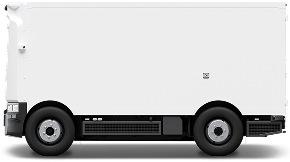
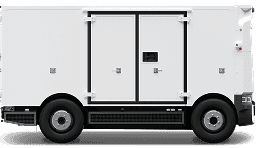
RoboVan solutions are designed to create practical value for repeatable delivery tasks, predictable routes, and structured operating environments.
What are the challenges for autonomous vehicles?
However, several challenges still limit large-scale adoption. Scaling autonomous logistics from pilots to broad deployment requires progress across four fronts at once: technology, regulation, cybersecurity, and social acceptance.
Technical limitations remain tied to operational boundaries
The most advanced autonomous logistics systems remain confined to their defined Operational Design Domain (ODD). Even at Level 4, a vehicle is usually only able to operate safely in certain routes, road types, weather conditions, and traffic environments.
This restriction is not a flaw but an intentional design parameter to ensure safe operation. However, it also clearly demonstrates the boundary between “early-stage commercial deployment” and “full-network large-scale implementation”.
The difficulty is that the real-world urban delivery environment is full of uncertainty. Even in closed or semi-closed logistics areas, pedestrians, loading and unloading equipment, temporarily stacked goods, and non-motorized vehicles may suddenly appear, road markings may be unclear or degraded over time, or there may be other obstacles.
When it comes to urban public roads, the situation becomes even more complicated: mixed traffic, randomly parked cars, road construction, unpredictable pedestrian behavior, delivery scooters, courier vehicles, and other curbside delivery activity. Furthermore, driving habits vary from place to place. These edge cases remain some of the hardest situations for autonomous systems to handle reliably.
Weather adds to the chaos. During heavy rain, fog, glare from the sun, or poor visibility, the accuracy of perception devices such as cameras and lidar will decline. There are also rare but highly challenging scenarios, such as debris falling on the road, animals suddenly appearing, unexpected road configurations, or roads becoming temporarily inaccessible. These are still being tested by the most advanced autonomous decision-making systems.
As a result, autonomous logistics vehicles are not yet a universally deployable solution. Their current value lies in solving specific logistics problems under specific operating conditions.
Regulation and liability remain fragmented
The regulation of autonomous logistics vehicles varies greatly from one place to another. Regulatory approaches differ across markets, particularly in areas such as testing permits, remote operations, safety supervision, accident liability, and commercial approval processes.
For autonomous logistics vehicles to achieve large-scale development, the industry urgently needs a more unified regulatory framework. Ideally, commercial operation access, data retention management, accident reporting processes, remote intervention rules, and insurance liability frameworks would be incorporated into a unified standard.
The core challenge is not only obtaining road permits, but also establishing a governance system that allows operators, manufacturers, insurance companies, and local authorities to cooperate.
Cybersecurity is now a safety issue, not just an IT issue
Autonomous logistics vehicles are connected cyber-physical systems that combine sensors, software, communication networks, and vehicle control systems. The advantage of connectivity is that it enables real-time visibility into operations, scheduling, diagnostics, and security management. The trade-off is that connectivity also expands the potential attack surface.
In the logistics scenario, a network breach can result in more than a loss of data. If the control system, communication lines or remote operation interface are hacked, a successful attack could potentially create physical safety risks. Because of this, cybersecurity in autonomous logistics must be treated as a core safety issue and cannot be left to the IT department to deal with.
Industry standards such as ISO/SAE 21434 provide a unified cybersecurity engineering framework, which is an important step. Cybersecurity must be treated as an ongoing engineering and operational priority.
Social acceptance and workforce disruption cannot be ignored
When discussing autonomous logistics, most people focus on the maturity of the technology, but the social impact is just as important. Millions of people worldwide work as delivery drivers, couriers, and commercial vehicle operators. Any technology that changes these roles naturally raises concerns about employment and workforce transition.
In the long run, autonomous logistics may give rise to new jobs, such as those for remotely managing fleets, scheduling, optimizing routes, providing security, and maintaining systems. At the same time, these positions are not one-to-one with traditional driver positions, and the pace of transformation will not be the same for different regions and groups of people.
Therefore, how far autonomous logistics vehicles can go in the future largely depends on whether governments, enterprises, and technology companies can develop a convincing transformation plan. Success will depend not only on the technology itself, but also on how companies help workers adapt to new roles.
What is the economic impact of autonomous vehicles?
Autonomous logistics is often framed as a labor-cost story, but its economic implications are broader. If deployed at scale, it has the potential to reshape cost structures, fleet utilization, warehouse geography, and the organization of logistics networks.
The most immediate effect is on vehicle productivity. Because human-driven operations are limited by working-hour rules and driver availability, van utilization is often lower than network demand would justify. Autonomous vehicles could increase usable operating hours, which in turn may improve asset turnover and reduce the cost of serving fixed routes or recurring logistics corridors.
But the second-order effects may be even more important. If transfer routes become more automated, operators can redesign where inventory sits, how frequently goods move, and how late in the order cycle they can still promise next-day or same-day delivery. Over time, that could influence warehouse placement, micro-fulfillment strategy, and the balance between centralized and distributed logistics nodes.
Autonomous logistics could also affect resilience economics. During periods of labor disruption, driver scarcity, or temporary spikes in demand, a partially autonomous logistics network may be better positioned to maintain service continuity than a network dependent entirely on human scheduling capacity.
At the same time, these gains come with real transition costs. Some driving roles, particularly repetitive fixed-route transport, will be more exposed to automation than others. The long-term economic value of autonomous logistics will therefore depend not only on whether it lowers operating costs, but also on whether the surrounding labor transition is managed effectively through retraining, redeployment, and new operating roles.
What are the infrastructure requirements for autonomous vehicles?
Autonomous logistics cannot scale through vehicle technology alone; it depends on a wider infrastructure stack.
Physical infrastructure
The operational stability of autonomous vehicles depends largely on the surrounding road environment. Clear lane markings, prominent signage, well-maintained road surfaces, and standardized loading areas all contribute to more reliable system operation.
Curbside pickup zones are a particularly overlooked piece of this: without dedicated, clearly marked spaces for autonomous vehicles to stop, load, and hand off goods, vehicles are forced to double-park, circle the block, or rely on human intervention, undermining exactly the efficiency gains autonomy is supposed to deliver.
Charging infrastructure is equally foundational for electric autonomous fleets; without high-capacity, strategically placed charging stations along key routes and at depots, vehicle range and duty cycles end up constrained by energy logistics rather than by the driving technology itself.
Beyond physical infrastructure, autonomous vehicles also rely on a digital layer. HD maps provide detailed information about road layouts, lanes, curb locations, and surrounding infrastructure.
This digital layer is also expected to enable real-time communication between vehicles and their surroundings. Vehicle-to-everything (V2X) communication allows vehicles to exchange data with other vehicles, infrastructure, and pedestrians.
Together, these elements form the broader digital infrastructure that autonomous delivery depends on. They create a connected layer of maps, sensors, and communication networks built on top of the physical road network.
In closed and controllable logistics locations such as airports, ports, and industrial parks, the speed of infrastructure upgrading, including HD mapping, dedicated charging bays, and V2X-enabled zones, is much faster than that of public roads. This is one of the main reasons why these environments are often among the first places where autonomous vehicle pilots are deployed.
Standards and interoperability
As more and more autonomous logistics vehicles are now adopted for commercial use, cross-system and cross-institutional connectivity will become a central challenge.
Operating enterprises, regulatory authorities, and infrastructure owners and operators need to reach a unified consensus on aspects such as the norms for reporting safety data, remote intervention agreements, software update governance mechanisms, and emergency accident handling procedures.
Remote fleet management adds another layer to this: when human oversight shifts from being inside individual vehicles to monitoring many vehicles at once from a central operations center, questions of latency, connectivity redundancy, and clear escalation protocols between the remote operator and local emergency responders become a standards issue in their own right, not just an operational one. Otherwise, autonomous vehicle companies will always face numerous integration challenges.
Institutional infrastructure
Finally, there is the institutional infrastructure: permit frameworks, insurance models, liability allocation, operating approvals, and the public-sector capacity needed to review and govern these systems responsibly.
Regulatory progress may ultimately become the biggest bottleneck. Autonomous logistics is not only a transportation technology; it is also a regulatory and organizational challenge that requires coordination among local authorities, logistics operators, site owners, insurers, and vehicle manufacturers.
From industry challenge to real-world deployment
The future of autonomous delivery will depend on whether the industry can translate technical feasibility into sustainable value.
Repetitive logistics routes, fixed transfer routes at airports and ports, internal operations within industrial parks, and fixed distribution lines in cities have now all become the most practical testing grounds for autonomous logistics.
These environments allow operators to solve practical logistics challenges while gradually building operational data, refining safety management processes, and demonstrating performance to regulators. Over time, this creates a foundation for broader commercial deployment.
Zelostech RoboVan solutions are designed to help logistics operators automate repetitive last-mile delivery tasks, improve operational efficiency, reduce dependence on driver labor availability, and build scalable autonomous delivery networks in real-world operating environments.
By focusing on structured commercial environments, including airport logistics, port operations, postal services, industrial parks, and urban delivery routes, Zelostech enables customers to achieve measurable operational improvements while autonomous technology continues to mature.
Conclusion
The value of autonomous delivery vehicles extends far beyond replacing human drivers. They enable logistics operators to build more efficient, resilient, and scalable delivery networks while improving safety and service quality.
Significant challenges remain, including weather adaptability, regulatory development, and infrastructure readiness. The future of autonomous logistics will depend not only on technological progress, but also on clear operating frameworks, industry-wide standards, and collaboration among technology providers, logistics operators, and regulators.
Companies that can bridge the gap between autonomous technology and real-world logistics operations will be well positioned as the industry matures. By focusing on structured, high-value operating environments, Zelostech aims to help logistics operators deploy autonomous delivery solutions where they can deliver measurable operational value.