The Rules That Decide Whether Delivery Robots Use Sidewalks or Roads
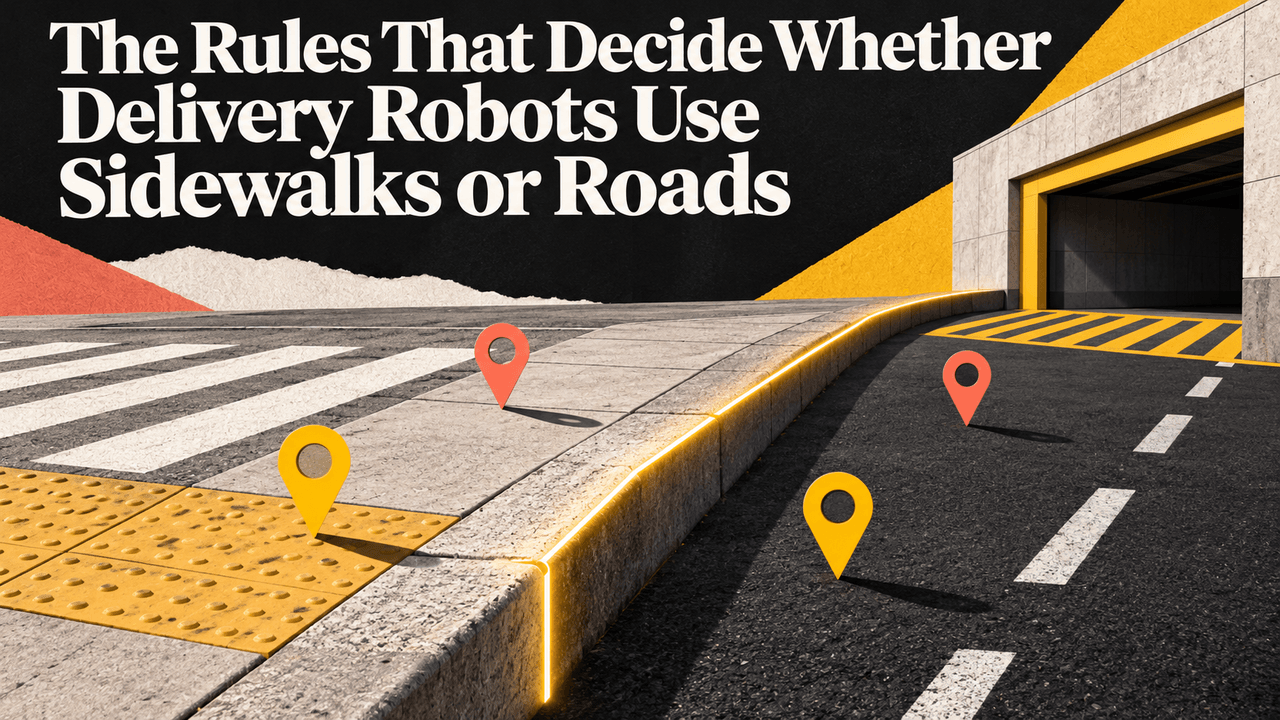
The last 200 metres of a parcel journey can be the hardest to approve. A small robot leaves a shop and heads along the pavement; a cargo vehicle brings several orders by road to a loading bay. The customer may see both as automated delivery, but traffic law sees two different users of public space. Crossing the kerb changes the vehicle category, the authority involved and the safety duties owed to pedestrians.
There is no global “right to deliver” on footways. Even where a jurisdiction expressly permits a personal delivery device, the right may end at a road edge or depend on an operator’s authorisation. A logistics team should map the entire trip, including crossings, rather than choose a robot first and look for a permissive rule afterwards.
Florida grants pavement access, with a hard road boundary
Florida’s 2026 statutes give a defined personal delivery device access to sidewalks and crosswalks, subject to local-authority rules. On those surfaces it has pedestrian-like rights and duties, must obey signals and must yield to people on foot. The operator must actively control or monitor its navigation. Florida also requires a device identifier and an operator to carry at least $100,000 in general liability coverage for combined device operations.
The same provision bars a personal delivery device from a public highway except where necessary to cross at a crosswalk. Florida defines the device as electrically powered, intended primarily to transport property on sidewalks and crosswalks, subject to the applicable weight limit and with a maximum speed of 10 mph. A cargo van cannot inherit those sidewalk rights by fitting sensors or operating at walking pace. Nor does the statute answer how a delivery van should stop legally beside the robot’s collection point. The two parts of the trip remain separate planning decisions.
Pennsylvania lets the route change surfaces, but controls the operator
Pennsylvania uses a different model. A personal delivery device can operate in a pedestrian area or, under the statute’s conditions, on a roadway, shoulder or berm. Its authorisation has operational phases: the first keeps a remote operator within 30 feet and line of sight; the second permits remote monitoring with the ability to override the driving system. The law requires the device to yield to pedestrians and cyclists in pedestrian areas and directs it towards a practicable shoulder before other options on a road.
Roadway access has further limits. The law generally excludes roads posted above 25 mph unless a specific state or municipal exception applies within a 35 mph ceiling, and it excludes interstate highways and freeways. Municipalities can also prohibit operation where they determine a hazard after consultation with the authorised entity. The operator must notify the municipality at least 30 days before starting local operations. For a route planner, “the robot can use the road” is only the opening line of a much longer decision about which road, which phase and which people are accountable.
Japan treats a qualifying machine like a pedestrian
Japan’s April 2023 framework for remotely operated small vehicles offers another route to pedestrian space. Qualifying devices are structurally limited to 6 km/h and to a compact size, and their users generally follow pedestrian traffic rules. Police guidance points to footways and roadside strips, with priority given to people on foot. Before beginning remote operation on public roads, the user must file a notice with the public safety commission responsible for the area. If the route crosses multiple prefectures, notice is required for each relevant commission.
That route depends on meeting the statutory device category. A larger or faster automated logistics vehicle cannot adopt the small-robot pathway through a software speed setting. Japan’s police also distinguish the notification regime from road-use permits for experiments involving other sidewalk-running robots. Where a proposed machine falls outside the defined class, the operator needs a fresh legal analysis rather than assuming that Japan’s support for delivery robots covers it.
Singapore starts from a prohibition and grants named exemptions
Singapore’s Land Transport Authority says autonomous mobile robots are generally prohibited on public paths as motor vehicles under the Active Mobility Act. Organisations can seek a ministerial exemption for a defined use. The difference is visible in a 2026 order for Delta Electronics’ AIDEN delivery robot: it names the robot, specified Bendemeer Road footpaths, permitted purposes and a fixed period. It sets a 6 km/h programmed limit and conditions for lights, intervention and insurance.
The order does not authorise other robot models on other paths. LTA also distinguishes public from non-public paths: autonomous robots on non-public paths fall outside the Active Mobility Act, although operators may still need the agreement of the relevant owner or site management. A route crossing from a private retail site to a public footway therefore needs both sides of that boundary mapped. The Singapore example illustrates a controlled exception, not an absence of regulation or a general rejection of autonomous logistics.
The kerb is a handover point, not a technical detail
Suppose a retailer moves several orders from a distribution centre to a neighbourhood shop. A vehicle on a retail replenishment run can complete the consolidated leg; staff then receive the goods and arrange the final customer handover. A pavement robot could serve that last leg where local law allows it, but it would need its own compliant category, route and operating arrangement.
The delivery contract should say who owns each parcel at the transfer, who responds when a machine stops and whether the recipient can reach the collection point. Its kerbside stop should be checked against local loading rules as carefully as the robot’s footway route. Without a workable handover, permission for either machine may produce a service that cannot deliver reliably.
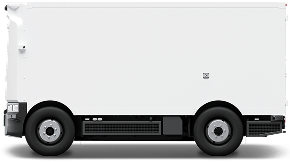
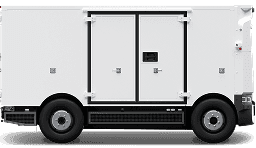
This is where Zelostech’s product context is relevant without treating its vehicles as pavement robots. Its Z5 RoboVan is presented as a road-going cargo vehicle for express, postal and retail work. In such a plan, the legal question would be how that vehicle reaches the shop and where staff can unload it. The four pavement-device regimes above do not establish a right for a Z5 to use a sidewalk, and the product page is no substitute for a local road approval.
For a cross-border fleet, compare the complete delivery leg rather than the robot alone: vehicle class, public-space surface, operator duties, stopping place and transfer of goods. Once those elements are placed on the same route map, it becomes much clearer which technology fits each segment and which authority needs to approve it.