Autonomous Delivery Rules Change at Canada’s Provincial Borders
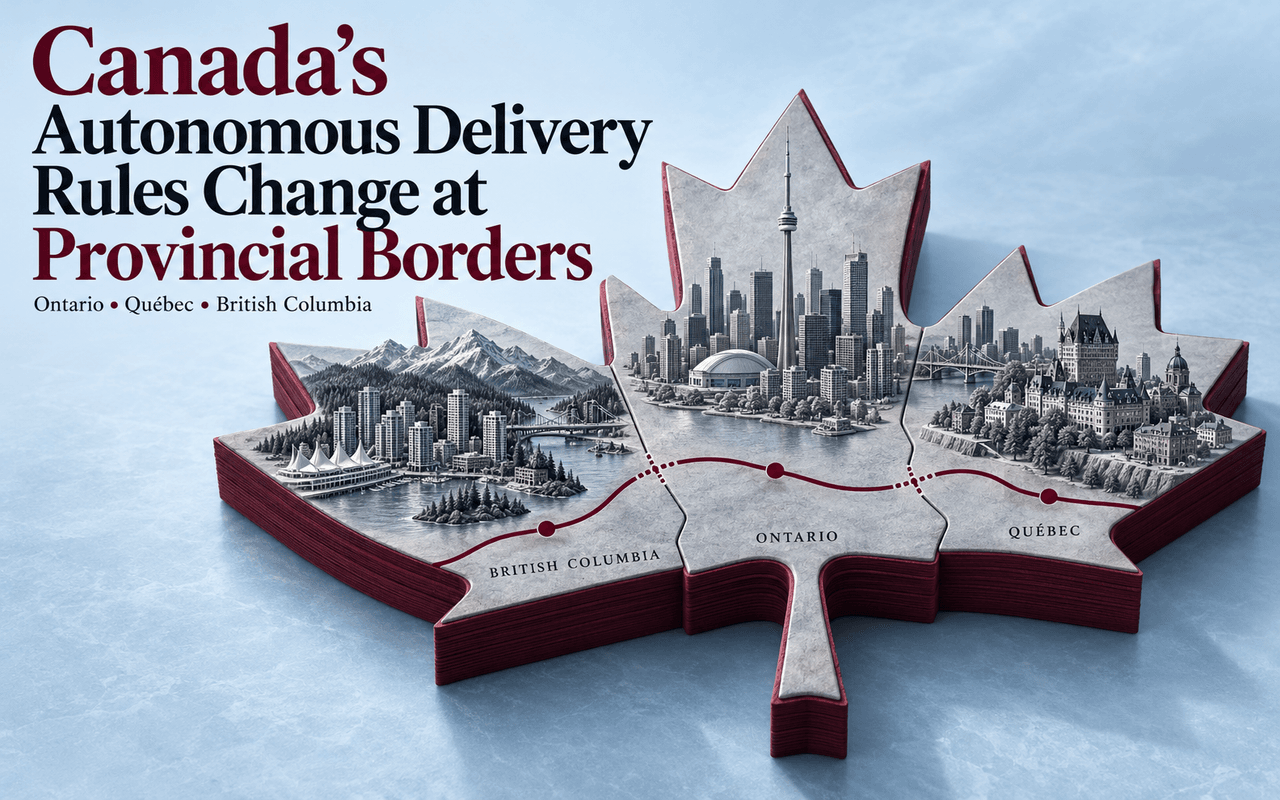
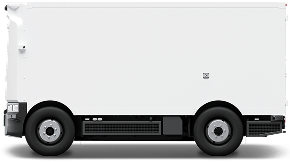
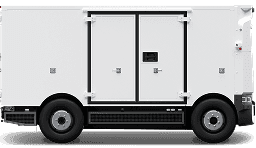
A logistics company could design the same short delivery-van journey for three Canadian cities: a warehouse to a nearby collection centre, with a known load and a repeatable schedule. The operating plan may be familiar, but the road authorisation question changes at the provincial border. Ontario, Québec and British Columbia each offer a different answer for Toronto, Montréal and Vancouver. Canada sets federal requirements for new and imported vehicles, while provinces control road use and trials. The relevant provincial rules and vehicle category have to be established before a customer route can be proposed.
One federal vehicle layer, three provincial road decisions
Transport Canada's Safety Framework 2.0 describes road safety as a shared responsibility. The federal government regulates the safety performance of new and imported motor vehicles and equipment. Provinces and territories set conditions for registration, traffic rules and on-road trials; municipalities may also control streets and kerb access. An autonomous van must fit both the applicable vehicle rules and the local operating pathway.
This division matters when a supplier says its vehicle is ready for Canada. Readiness can mean that a vehicle has a route to importation or meets relevant federal standards. It does not establish that a province has accepted driverless movement on a given road. The boundaries become still more important in freight: a road-going van, a heavier commercial motor vehicle and a small pavement device can fall into different legal categories. The comparison below concerns road-going delivery vehicles, with one separate Ontario truck programme noted only to clarify its scope.
Ontario: approved testing, including a driverless stream
Ontario's Automated Vehicle Pilot Program covers SAE Level 3–5 passenger and commercial motor vehicles under specified conditions. It began in 2016 and has been extended to 13 October 2027. Since 2019, the programme has allowed driverless testing in certain circumstances. An organisation must apply to the Ministry of Transportation; a participant changing a plan to test without a driver must submit a new application. Approval is tied to the testing plan and its conditions, rather than being a province-wide commercial delivery entitlement.
The driverless conditions are concrete. Applicants must describe where the vehicle is designed to operate, show how it can be monitored and, if necessary, brought to a safe stop. Ontario requires a copy of the signed approval in the vehicle and with the remote operator, along with testing reports and collision notifications. For a depot-to-customer delivery leg, those requirements directly affect staffing, remote oversight and incident procedures.
Ontario also began a separate automated commercial motor vehicle pilot in August 2025 for specified truck configurations above 4,500 kg. It runs to August 2035 and has both supervised and driverless streams; in the latter, an assistant in the vehicle or elsewhere in Ontario must be available to oversee it. That programme may interest heavy freight operators, but its weight and configuration criteria should not be assumed to cover every compact delivery RoboVan. The correct Ontario application depends on what is actually being put on the road.
Québec: a provincial pilot for Level 4 road use
Québec's public guidance, updated in July 2026, generally bars autonomous vehicles from public roads and certain private roads open to public traffic. There are two stated exceptions: an eligible Level 3 vehicle whose sale Transport Canada has authorised, and a Level 3 or higher vehicle within a provincial pilot project. The first exception does not provide a pathway for Level 4 delivery vans.
For a proposed trial, Québec requires an application before testing on public roads or private roads and premises open to the public. The submission must identify the vehicle, its automation level, territory and planned route, safety measures, partners and maintenance arrangements. A ministry and public automobile-insurance body committee reviews applications. A warehouse access road open to visiting carriers or customers may therefore require closer classification than a simple “private site” label suggests.
Québec's route information request is especially useful for freight planning. A proposed service cannot be assessed only by naming two terminals: the applicant must describe urban or rural conditions, speed limits and road infrastructure along the way. Earlier testing evidence can support the safety account, while maintenance records show how the vehicle will remain fit for use during the project. These are materials for a provincial decision, not a substitute for one.
British Columbia: a default prohibition with a future opening
British Columbia's Motor Vehicle Act, section 303.2, prohibits driving or permitting the driving of Level 3, 4 or 5 automated vehicles on a highway unless regulations provide otherwise. The province's public guidance describes a possible pilot or regulatory exception. The existence of that legal power is different from an open invitation to run any driverless van. A Vancouver-area operator should establish whether a specific exception and conditions exist before scheduling a public-road trial.
The Act allows future regulations to set limits, safety measures, reporting requirements and insurance or permit conditions. That flexibility is relevant for future projects, yet it is an enabling power rather than a current blanket trial route. Procurement plans that assume immediate public-road access in British Columbia would therefore get ahead of the published rules.
A port case that sharpens the route question
The distinction between a site and the roads around it has a practical counterpart in Zelostech's autonomous logistics work in Europe. The Singapore-based company reported in September 2026 that RoboVans would continue operating on the K102 route at its Experience Center, established with the Antwerp-Bruges Port Authority. The centre lets logistics and port stakeholders observe the vehicles in a live port setting and examine potential intra-port transport tasks. The announcement does not identify a specific cargo stream or prove authorisation in Canada; it describes continuing port operation and evaluation in Belgium.
The same boundary matters at Canadian ports, airports and industrial estates. A facility may control its gates and loading area while vehicles outside those gates are subject to provincial road rules. Even inside the site, roads or grounds open to the public can matter, especially under Québec's published guidance. Before selecting a port logistics application, operators should identify every segment where the vehicle mixes with public traffic, who has authority over it and what the local trial or exception covers. That route map makes regulatory conversations more precise and stops a facility demonstration being mistaken for wider road approval.
Canada offers no single provincial answer to “can we start deliveries?” Ontario provides a conditional test application, Québec requires a provincial pilot for higher automation, and British Columbia starts with a prohibition unless an exception is made. Federal vehicle compliance remains relevant in each. The same delivery model can therefore face materially different approval routes across Canada, even when the vehicle and customer task remain unchanged.