China’s L4 Autonomous Logistics Vehicle Policy Overview
China’s autonomous logistics market includes vehicles working under several regulatory arrangements. National intelligent connected vehicle programmes sit alongside local schemes for unmanned delivery, while safety standards are developing to support wider adoption. A report of regular parcel delivery and an announcement of product testing can both describe genuine progress, but they represent different permissions and operating stages.
For overseas logistics professionals, the most useful starting point is vehicle classification. A small delivery vehicle managed under local non-motor-vehicle rules follows a different path from a road-going goods vehicle subject to national motor-vehicle admission. “L4” describes driving automation; it does not determine which approval scheme applies.
Understanding this structure makes China’s commercial progress easier to assess. The policy question is how a particular vehicle enters service, what goods movement its permission covers and how its operation can expand.
The national admission and road-access programme
In November 2023, four central government departments established a pilot programme for intelligent connected vehicle admission and road access. It covers vehicles equipped with Level 3 and Level 4 driving automation. Products obtaining admission can enter road-use pilots within designated areas, while transport businesses must also meet the relevant operating qualifications and management requirements.
The Ministry of Industry and Information Technology, MIIT, subsequently explained that consortium selection is the application stage, rather than permission to operate. The process includes product testing and safety assessment, an admission decision, registration and road operation within specified limits. Admission can carry restrictions such as the approved area and validity period.
Local delivery schemes address specific vehicles and activities
Beijing’s 2023 unmanned delivery vehicle rules illustrate a separate local approach. The category includes vehicles 1.5–3 metres long and 0.9–1.1 metres wide, excluding sensors. Vehicles within this scheme are managed by reference to non-motor vehicles, normally use non-motorised lanes and operate at no more than 15 km/h. The rules also provide for keeping to the right where no such lane exists and temporarily using an adjacent motor-vehicle lane to pass an obstruction.
The rules also distinguish testing from commercial demonstration. Testing under this instrument is intended to assess vehicle capability and cannot include delivery work or delivery charges. Commercial demonstration covers commercial delivery on designated roads. Before applying for commercial demonstration, the same vehicle model must complete at least 240 hours or 1,000 kilometres of autonomous road testing in the proposed area, subject to the stipulated traffic and accident conditions. The demonstration area must remain within the tested roads and areas. For a delivery network, adding a destination can therefore require further route testing before commercial demonstration is authorised.
Beijing’s dimensions and speed limit apply to the category defined in that instrument. They do not establish national specifications for larger cargo platforms.
Local policy is also supporting regular deployment. In April 2026, the Shandong postal administration reported that Qingdao had completed its provincial annual autonomous delivery deployment target ahead of schedule. It described 204 opened intelligent connected vehicle testing roads across two batches and work towards wider access through a negative-list approach. This indicates organised expansion within a local framework.
A national automated-driving safety standard adds another layer
Mandatory standard GB 44721–2026 was published on 30 July 2026 and is scheduled to take effect on 1 July 2027. According to MIIT, it covers category M and N vehicles equipped with L3 or L4 systems, excluding automated parking systems. Its publication establishes a forthcoming safety baseline for relevant products; the implementation date remains important when describing current requirements.
The standard addresses manufacturer safety management, performance of the driving task, minimum-risk strategies, user information and validation. MIIT describes assessment using simulation, test tracks and road testing, supported by review of safety documentation and organisational capability.
For autonomous logistics, this connects the initial product assessment with continuing operation. Software changes, newly encountered conditions and safety records all belong to the vehicle’s lifecycle. The standard’s scope also reinforces the need to distinguish nationally regulated motor vehicles from equipment operating under a separate local delivery category.
Why recurring parcel transfers are commercially relevant
A parcel network contains several transport tasks between sorting and final handover. Goods may move repeatedly from a local depot to collection points, branch facilities or staffed delivery stations. Automating that transfer leaves sorting and customer service with local teams while reducing the need for a driver on each repeated journey.
These services have identifiable destinations and demand patterns, making the permitted operating area commercially meaningful. A route authorisation determines which part of the network the vehicle can serve. Expansion becomes useful when it adds a receiving point, increases available service hours or enables a recurring movement previously handled manually.
DHL in Changzhou shows how permission connects with service
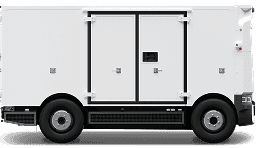
Singapore-based Zelostech supplies the Z5 RoboVan used in DHL’s Changzhou public-road operation. Located in China, the deployment connects an express logistics provider with a local manufacturing customer. It shows how an approved autonomous vehicle can become part of an international logistics company’s daily service.
In its June 2026 announcement, Zelostech reported that the vehicle had obtained public-road authorisation and autonomous-driving operational approval and was running in continuous commercial service. The project was also included in Changzhou’s first batch of commercial autonomous-system pilot programmes. Here, inclusion in a programme labelled “pilot” coexists with a reported commercial transport service; the label alone does not describe the operating stage.
The route connects a DHL Express Service Center with a display-equipment customer’s production site. Zelostech’s announcement reports approximately 38 kilometres per trip and an average transit time of 1.5 hours, alongside extended cut-off times and greater scheduling flexibility. Those details explain the business purpose: connecting a production facility with an express network when conventional scheduling constrained responsiveness.
This is a different proposition from a small pavement robot delivering individual orders. The Z5 RoboVan performs the transport leg, while the customer and service centre remain the handover points. The approval status and operating details described here are based on Zelostech’s announcement. They do not establish authorisation for other vehicles, routes or cities.
From policy announcements to real delivery operations
The Changzhou example also shows why Beijing’s compact-vehicle rules should not be applied to every Chinese project. A buyer needs the approval basis for the proposed vehicle and location, rather than dimensions or speed limits copied from another city’s scheme.
Across postal, warehouse and retail logistics applications, the commercially useful questions differ. An express connection may depend on a later collection cut-off; a replenishment run may depend on arriving before a store opens. The permission must cover the journey and operating conditions needed to deliver that benefit.
China’s national admission programme, local delivery rules and forthcoming safety standard address different parts of this process. Evaluating a project means reading them alongside the specific authorisation and reported operating activity. For customers, a named route with a documented service purpose is more informative than a fleet announcement that leaves its permitted work unclear.