Last-Mile Delivery Management and Technology Trends for 2026 Logistics Teams
What Last-Mile Delivery Teams Are Managing in 2026
Route planning remains an important part of last-mile delivery management, but it is only one component of the operating model. Logistics teams also need to coordinate vehicles, drivers, loading activities, delivery schedules, charging, depot operations, and customer-service requirements.
A route can be geographically efficient while still producing poor fleet utilization if vehicles spend too much time waiting for cargo, returning empty, or remaining idle between delivery windows. Labor availability creates another constraint, particularly for networks with frequent scheduled movements and repetitive routes.
This is where automation is becoming relevant. A defined route with predictable stops and recurring cargo movements can provide a more controlled environment for autonomous operation than an irregular route with constantly changing destinations.
The practical question for logistics teams is therefore how different vehicle technologies can be assigned to different transportation tasks while maintaining a reliable end-to-end delivery network.
Postal Networks Show Where Autonomous Delivery Fits
Postal logistics provides a useful example because its transportation patterns often include high-frequency, repeatable movements between distribution centers, processing facilities, collection points, and delivery areas.
Singapore Post, for example, has worked with Zelostech across several autonomous logistics scenarios. These include middle-mile transportation between distribution locations and collection points, internal movement within logistics hubs, and last-mile delivery concepts using customized autonomous locker vehicles. The partnership has also moved toward public-road driverless operations, making it a relevant example of how autonomous vehicles can be integrated into an existing postal network rather than operated as an isolated technology trial.
For logistics teams, the significance is the range of tasks involved. Autonomous vehicles can support internal logistics and recurring transportation movements while the broader network continues to use conventional vehicles where flexible human intervention is required.
Malaysia provides another example at an earlier stage of deployment. Zelostech and Pos Malaysia launched an autonomous postal logistics proof of concept at the National Mail Centre in Kuala Lumpur. The project is focused on postal and logistics operations and is intended to provide a foundation for future expansion into broader operating environments. Because it remains a PoC, its operational stage should be considered separately from commercial autonomous services already running on public roads.
Zelostech has also pursued strategic cooperation with 7X and Emirates Post in the Middle East. This reflects growing interest in autonomous logistics within postal networks, although strategic cooperation should not be treated as equivalent to a completed commercial deployment.
These examples point to an important consideration for postal operators: the value of autonomous delivery technology depends on where it is inserted into the network. A vehicle moving parcels between repeatable logistics points may have a different operating profile from a vehicle serving highly variable residential deliveries.
Commercial Autonomous Logistics Is Expanding Beyond the Final Stop
Autonomous logistics is also moving into recurring public-road transportation segments that sit between traditional logistics nodes.
In Singapore, DHL launched a licensed autonomous RoboVan on public roads using Zelostech technology. The vehicle operates continuously on a dedicated route between a DHL Express Service Center and a customer's production site, covering approximately 38 km per trip with an average transit time of about 1.5 hours. The operation has received public-road authorization and autonomous driving operational approval and is running as a commercial service.
This is not a doorstep last-mile route, but it is directly relevant to last-mile delivery management because it shows how autonomous transportation can become part of a larger logistics network. The route's repeatable structure allows the operator to use autonomous technology for a specific transportation segment while retaining other vehicle types for different tasks.
The reported operational benefits include greater scheduling flexibility, later shipment cut-off times, more consistent service delivery, and reduced reliance on traditional transportation resources. For logistics managers, these outcomes are more meaningful than vehicle automation alone because they connect the technology with measurable changes in daily operations.
How Autonomous Vehicles Fit Into a Mixed Delivery Fleet
Most delivery networks will continue to operate mixed fleets. Conventional vans remain useful for routes with changing destinations, complex customer interactions, irregular cargo requirements, or situations where immediate human intervention is necessary. Electric vehicles can reduce local emissions and operating costs while retaining conventional driving flexibility.
Autonomous vehicles are better suited to transportation tasks where the route, operating area, cargo flow, and schedule can be defined in advance. Examples include recurring depot-to-depot movements, warehouse or hub transfers, postal transportation, and selected last-mile routes with predictable delivery patterns.
Fleet planning works best when each vehicle is matched to the transportation task it can perform efficiently. The relevant factors include route length, cargo volume, operating hours, charging requirements, driver or remote-supervision requirements, vehicle utilization, and the frequency of human intervention.
This mixed-fleet model also changes how transportation managers evaluate automation. Instead of asking whether an entire delivery network can become autonomous, they can identify individual routes where automation can reduce labor requirements, increase utilization, or improve schedule consistency.
Integrating Autonomous Vehicles Into Existing Logistics Operations
Introducing autonomous vehicles into an operating network requires more than adding a new vehicle type. The route, cargo workflow, operating area, supervision model, and regulatory requirements need to work together.
A defined operating area can simplify deployment because the vehicle encounters a more predictable set of road and traffic conditions. Logistics teams also need to consider where cargo is loaded and unloaded, how vehicles interact with existing warehouse or depot processes, and how exceptions are handled when a route cannot be completed automatically.
Remote supervision is another operational consideration. Driverless operation does not remove the need for operational oversight. Instead, responsibility shifts toward monitoring vehicle status, managing exceptions, and maintaining continuity across the autonomous fleet.
Regulatory approval must also match the intended operating environment. Singapore, for example, has an established framework for autonomous vehicle testing and deployment, with LTA assessment processes covering areas such as vehicle testing, documentation, remote operations, and deployment readiness. The approval path therefore needs to be considered as part of route and operational planning rather than treated as a final administrative step.
Measuring Whether Autonomous Technology Solves the Transportation Problem
The performance of an autonomous delivery system should be evaluated using the same operational metrics that logistics teams use for other transportation investments.
Transportation time is one measure. If an autonomous route produces more consistent travel times or allows shipments to move during periods when driver availability is limited, it can create value even without changing the physical route.
Labor requirements are another. A recurring route that previously required dedicated driving resources may require a different staffing model when autonomous operation and remote supervision are introduced.
Vehicle utilization also matters. Higher utilization across scheduled routes can improve the economics of the fleet, particularly when vehicles can operate for longer periods without the constraints associated with conventional driver shifts.
Reliability should be measured through route completion, service consistency, intervention frequency, downtime, and exceptions. Operating cost provides the final commercial measure, combining vehicle utilization, labor, energy, maintenance, supervision, and other recurring operating expenses.
These measurements also help distinguish a technology demonstration from a commercially useful deployment. A successful PoC can prove that a vehicle can complete a route, while a commercial operation needs to show that the route can deliver repeatable operational and financial value.
What Logistics Teams Should Prioritize in 2026
For 2026 planning, autonomous delivery technology should be evaluated at the route and network level. The most suitable opportunities are likely to be transportation tasks with recurring schedules, predictable operating areas, stable cargo flows, and enough utilization to justify the technology and operational infrastructure.
Postal networks, logistics hubs, industrial facilities, and dedicated middle-mile routes can provide these conditions. Last-mile applications can also benefit where delivery patterns are sufficiently structured to support autonomous operation.
The role of fleet management is consequently becoming broader. Logistics teams need to decide which routes should remain human-driven, which should use electric vehicles, and which can support autonomous operation. They also need the operational data to compare these choices over time.
Zelostech RoboVans for Commercial Logistics
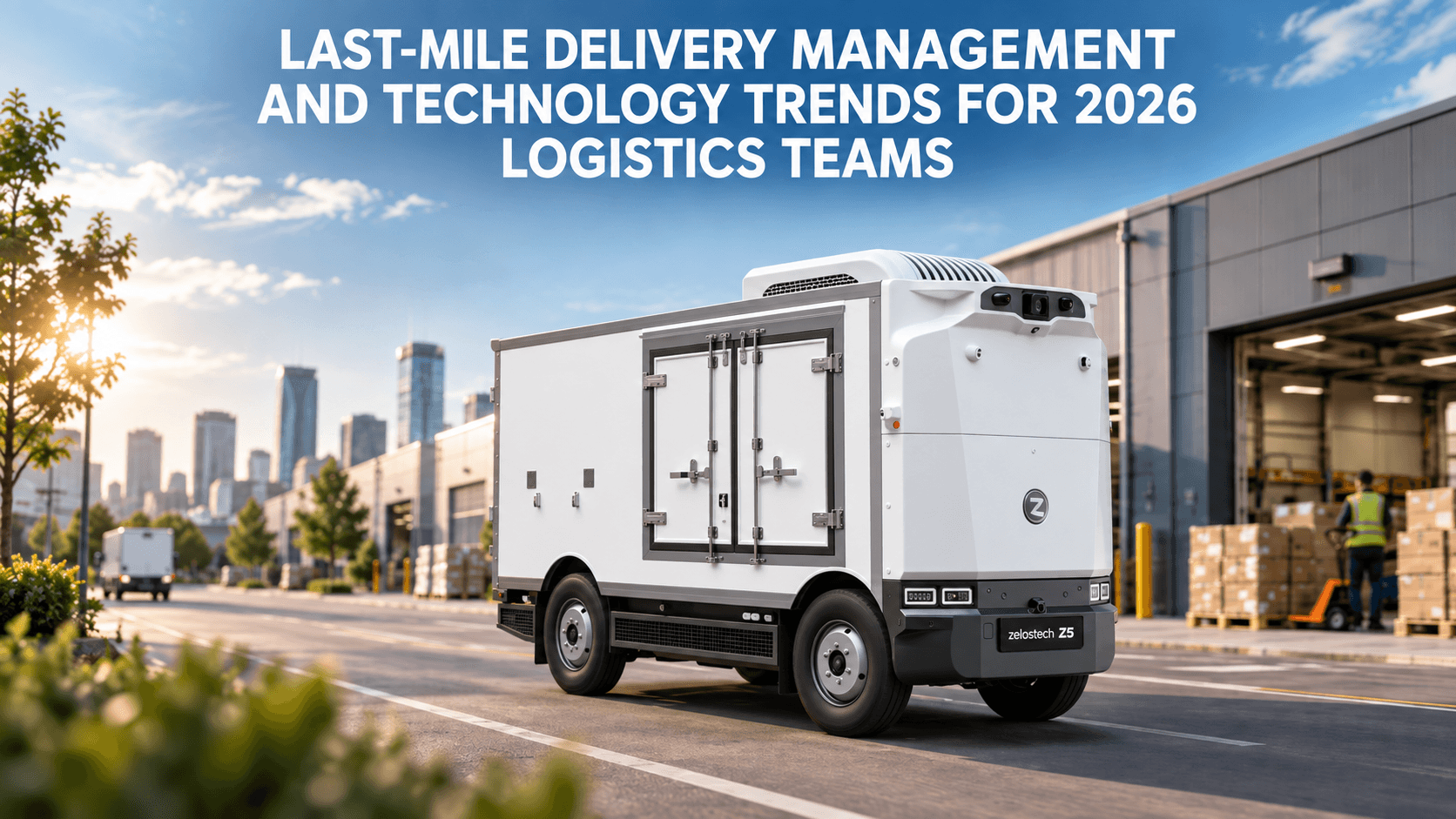
Zelostech develops RoboVan solutions for commercial logistics applications, including postal delivery, hub transportation, and recurring logistics routes. Its vehicle platforms are designed for different cargo and operating requirements, allowing logistics operators to select configurations according to route characteristics and transportation demand.
The Z5 RoboVan, for example, has a listed maximum range of 230 km, a maximum payload of 1,800 kg, and 6.2 m³ of cargo capacity. These specifications make vehicle capacity and route requirements important considerations when assessing where autonomous transportation can fit within a logistics network.
Zelostech's deployments with postal operators, retailers, and logistics providers provide examples of how autonomous vehicles can move from controlled operating environments toward public-road and commercial applications. The operational model varies by market and route, so deployment planning remains closely tied to regulatory requirements, route conditions, cargo workflows, and the required level of supervision.
For logistics teams evaluating autonomous delivery in 2026, the key question is where autonomy can create measurable value within the network. Zelostech’s deployments across postal, retail, and commercial logistics show how RoboVans can be applied to routes where operating consistency, utilization, and labor efficiency matter most.