Load Planning Starts Before the First Box Goes In
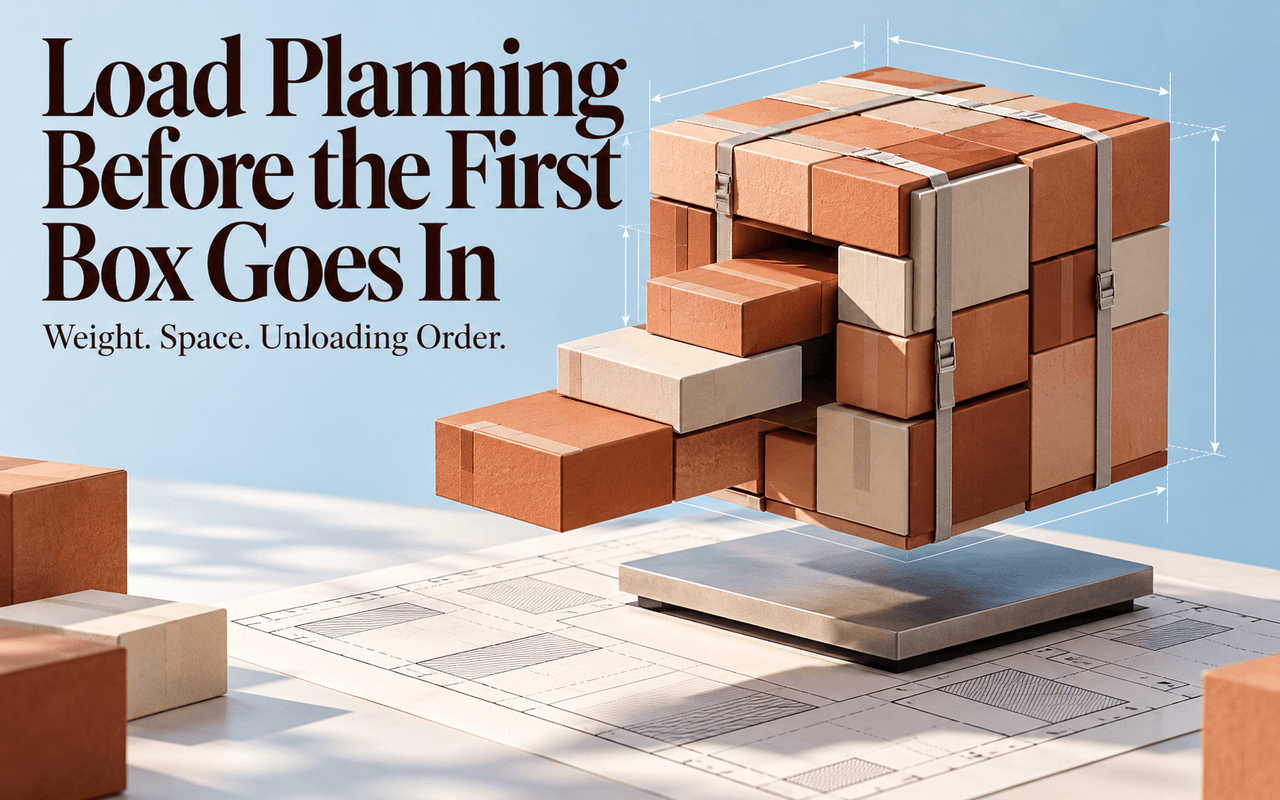
The cartons fit inside the vehicle, the doors close and the total weight appears acceptable. At the first stop, however, the delivery team cannot reach the right order without moving goods intended for the final receiver. The journey now includes an unplanned unloading operation, with nowhere suitable to place the displaced cargo.
Load planning should resolve that problem before loading begins. A workable plan connects the order list to the vehicle's limits, the physical arrangement of goods and the sequence in which people will remove them. Empty space and unused payload are only part of the decision.
The examples below concern packaged, non-hazardous goods on an illustrative delivery route. Their capacities and order quantities are planning assumptions. Any real arrangement must be checked against the particular vehicle, equipment, cargo and operating requirements.
What is load planning in a delivery operation
Load planning determines which goods travel together, where they are placed, how they are restrained and how they will be unloaded. The required inputs go beyond an order's item count. Capture packaged weight, external dimensions, handling-unit type, stackability, orientation restrictions and the receiving sequence.
Distinguish a product's dimensions from its shipping dimensions. Protective packaging, pallets, cages and other handling units consume space and add weight. Record the assembled unit that will actually enter the vehicle. A plan calculated from unpacked goods can pass on screen and fail at the loading position.
For retail replenishment, confirm what the receiver can handle. A store may accept loose cartons but lack equipment for a heavy pallet. The load must support the agreed handover method, and the delivery team needs access to the correct order without an improvised roadside rearrangement.
Keep the information attached to the shipment as the plan changes. A substituted package or added return collection may alter weight distribution, usable space and unloading access. The loading team should receive the current approved arrangement, rather than a printed version of yesterday's order list.
Weight and volume impose different limits
A vehicle can reach its weight limit while appearing half empty. It can also fill with lightweight goods before approaching its permitted payload. Check both dimensions independently. The usable load allowance must account for the particular configuration and anything else carried, including handling equipment where applicable.
Nominal cargo volume is an initial screening figure. Door openings, wheel housings, internal fittings, required clearances and the shape of handling units affect what can actually be placed inside. Dividing vehicle volume by carton volume does not prove that a workable arrangement exists.
The UK DVSA's load-security guidance treats loading, transport and unloading as connected responsibilities and specifically warns that removing part of a load can alter axle weights, stability and load security. For planning, placement, restraint and unloading sequence therefore need to be considered together. Local requirements and the vehicle's approved limits still govern the actual operation.
Weight distribution also changes as orders are removed. A safe departure arrangement needs to remain suitable after each delivery. Review the remaining load and restraint requirements at each stop, rather than assuming that a lighter vehicle automatically has an acceptable distribution of weight.
Compare two order combinations before choosing a vehicle
Order combination | Packaged weight | Packaged volume | Initial finding |
A: order 1, dense packaged goods | 700 kg | 1.5 m³ | First delivery |
A: order 2, boxed supplies | 450 kg | 2.0 m³ | Second delivery |
A total | 1,150 kg | 3.5 m³ | Weight exceeds the allowance by 150 kg |
B: order 3, lightweight cartons | 300 kg | 4.0 m³ | First delivery |
B: order 4, bulky packaged goods | 250 kg | 3.0 m³ | Second delivery |
B total | 550 kg | 7.0 m³ | Volume exceeds the initial allowance by 1.0 m³ |
Combination A cannot be accepted simply because there is substantial empty space. Splitting a separable part of an order or allocating different capacity requires a revised shipment plan and receiver agreement. Reducing restraint equipment or ignoring handling-unit weight is not an acceptable way to recover the missing allowance.
Combination B needs a different response. Even its simple volume calculation fails, and the actual package shapes may make the constraint worse. A larger suitable cargo compartment, a separate trip or an agreed order split may work. Compressing packaging or stacking goods beyond their approved limits cannot be assumed to solve it.
After a feasible combination is selected, test the layout against the stop sequence. For a rear-access arrangement, goods for the first receiver may need to remain accessible near the opening. Stability, restraint and the vehicle's load-distribution requirements take precedence over a convenient last-in, first-out rule. The best arrangement satisfies both handling and transport needs.
Use vehicle specifications to screen, then verify the arrangement
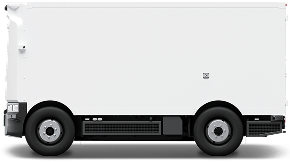
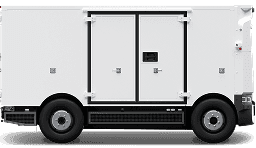
The contrast between the two combinations explains why one capacity number is insufficient when evaluating a RoboVan. Zelostech publishes a maximum load of 1,800 kg and cargo space of 6.2 m³ for the Z5 RoboVan. The separate weight and volume figures support an initial comparison; neither confirms that a particular collection of cartons, pallets or cages will fit and remain accessible.
For a proposed Z5 deployment, request the relevant cargo-compartment dimensions, access details and approved load-restraint information for the supplied configuration. Use the actual packaged goods in a loading assessment. The hypothetical 1,000 kg and 6 m³ allowances above should not be transferred to the Z5 or represented as its operating limits.
This assessment is particularly useful for autonomous delivery because the driving task and the cargo-handling task have different owners. Agree who loads, checks closure, confirms release and inspects the remaining load after a partial delivery. Vehicle autonomy does not establish that loading, unloading or rearranging cargo is automated.
Load plan optimization should compare feasible arrangements by their whole delivery cycle. An arrangement that carries one extra order but requires extensive unloading and reloading at every stop may reduce usable transport capacity. Measure handling time and failed access alongside the number of orders carried.
Give the departure team a short release check
Use a departure check after the physical load is complete. Each answer should refer to the actual load, with discrepancies returned to the responsible planner or loading lead. A digital plan is supporting evidence, not proof that the vehicle was loaded accordingly.
Identity and quantity: Do the handling units match the current manifest and destination sequence?
Capacity and arrangement: Are the actual weight, dimensions and distribution within the applicable limits?
Packaging and restraint: Are packages intact, approved restraint arrangements completed and doors correctly secured?
Unloading access: Can each receiver's goods be removed using the agreed equipment and method?
Release: Has the responsible person confirmed readiness, including any changes made during loading?
Keep the plan current when orders change
If an order is added after this check, reopen the affected parts of the plan. Adding a small carton can still block access to a restraint point or introduce a different handling requirement. The response should depend on what changed, not merely on whether the added weight seems negligible.
Review rejected loads and difficult deliveries to improve the next plan. Repeated volume failures may reveal poor packaging data, while repeated unloading delays may point to an unsuitable stop sequence. Load optimization becomes useful when those observations feed back into vehicle selection and loading decisions. A successful load is one the vehicle can carry safely and every receiver can accept in the intended order.