Malaysia's Regulatory Sandbox for Autonomous Delivery Vehicles Explained
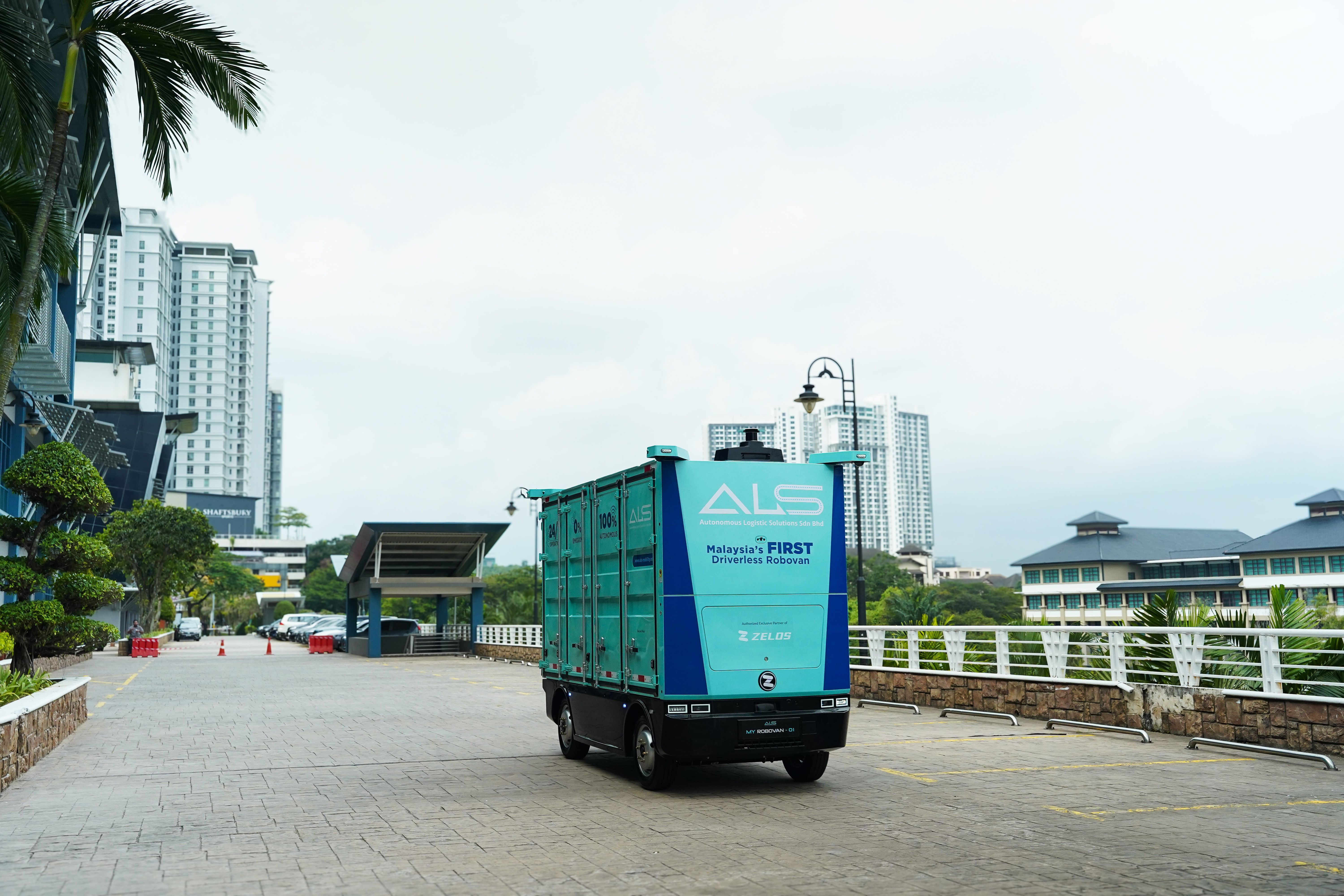
Malaysia's MyAV regulatory sandbox provides a structured path for autonomous vehicle testing on public roads. Explore how Cyberjaya is supporting Zelostech's L4 RoboVan trial and the development of autonomous logistics in Malaysia.
Malaysia has established a regulatory pathway for autonomous vehicle testing on public roads. The Malaysia Autonomous Vehicle (MyAV) programme, developed through the National Regulatory Sandbox, provides designated environments where autonomous vehicles can be tested under real-world road conditions.
For autonomous logistics, the most relevant development is taking place in Cyberjaya. Zelostech and Autonomous Logistic Solutions (ALS) have secured approval for an L4 autonomous logistics RoboVan to undergo public-road testing under Malaysia's Ministry of Transport AV regulatory sandbox. The trial is centered on the Cyberjaya MyAV route and is supported by a dedicated Remote Operations Center (ROC).
The programme follows an earlier autonomous logistics PoC with Pos Malaysia, moving the RoboVan from controlled postal operations toward regulated public-road testing.
How Malaysia's MyAV Sandbox Works
MyAV, or Malaysia Autonomous Vehicle, was developed through cooperation between Malaysia's Ministry of Transport, Futurise, local authorities, and other stakeholders. The first Cyberjaya AV testing route was endorsed in December 2020 under the National Regulatory Sandbox framework. Companies seeking to conduct trials are required to submit an application and Safety Management Plan for review.
The Cyberjaya route has expanded since its launch. The original testbed covered 7 km across two designated routes. An additional 15 km was added in 2025, bringing the route to 22 km for the next stage of autonomous vehicle trials. The expanded route includes urban roads, intersections, pedestrian crossings, commercial areas, business districts, educational institutions, and MRT stations.
This makes Cyberjaya more than a closed test track. It provides a defined public-road environment where autonomous vehicles can be evaluated in mixed traffic while remaining within an approved operating area.
For logistics operators, the distinction matters. Public-road validation needs to cover vehicle behavior as well as route management, remote supervision, operational procedures, and interaction with existing logistics workflows.
Why Cyberjaya Matters for Autonomous Logistics
The 22 km MyAV route gives L4 logistics vehicles an opportunity to operate in varied urban conditions without immediately moving into unrestricted deployment.
The route includes areas such as Persiaran APEC, Persiaran Cyberpoint, and Persiaran Rimba, exposing autonomous vehicles to intersections, pedestrian crossings, commercial activity, and other mixed-traffic situations. These conditions are relevant to logistics because delivery vehicles must maintain predictable operations while responding to changing road environments.
The public-road trial is also supported by Malaysia's first dedicated Remote Operations Center for autonomous logistics. Located at CoPlace 9 in Cyberjaya, the ROC was developed by ALS with the Selangor Information Technology & Digital Economy Corporation (SIDEC) and Cyberview.
The center provides real-time oversight through vehicle video feeds, telemetry, route status, and system diagnostics. The RoboVan trials are expected to use the ROC to support monitoring and operational supervision while the vehicle operates on public roads.
This infrastructure addresses an important part of L4 logistics operations: driverless vehicles still require an operating system around them. Remote monitoring, exception handling, route management, and operational coordination all need to function alongside the vehicle.
Zelostech's RoboVan Moves From PoC to Public-Road Testing
The Cyberjaya programme follows the autonomous logistics PoC launched by Zelostech, Pos Malaysia, and ALS in January 2026.
The PoC began at Pos Malaysia's National Mail Centre in Kuala Lumpur and focused specifically on postal and logistics operations. It was designed as a phased programme, with the initial operations taking place in a controlled environment and future expansion planned toward broader operational and public-road environments.
The public-road programme introduces a different set of operating conditions. Instead of validating the RoboVan primarily within a logistics facility, the Cyberjaya trial will evaluate the vehicle on designated public roads and in real mixed traffic.
That creates a clear progression for the Malaysian programme: controlled postal logistics operations first, followed by public-road validation under the MyAV framework.
The distinction is important because a successful controlled-environment PoC does not automatically establish that an autonomous logistics vehicle is ready for public-road deployment. The latter requires additional evidence covering road behavior, supervision, safety procedures, and operational reliability.
What the Singapore Experience Adds
Singapore provides a reference point for the operating experience behind the Malaysian programme, but the regulatory and operational focus remains different.
Zelostech's Singapore operations progressed from public-road testing in 2024 to remotely supervised driverless supply-chain operations in 2025. The company also worked with FairPrice on supervised autonomous logistics operations before receiving approval for fully driverless commercial operations on public roads. (zelostech.ai)
That experience is relevant to Malaysia because public-road autonomous logistics involves more than the vehicle itself. Route planning, remote supervision, safety procedures, and integration with logistics operations all have to work together.
Cyberjaya provides a new environment in which that experience can be evaluated against Malaysian road conditions, traffic patterns, and regulatory requirements.
What the Cyberjaya Trial Will Measure
The most useful results from the trial will come from operational data collected over repeated public-road runs.
Vehicle performance can be assessed through route completion, availability, system reliability, and responses to different traffic conditions. Remote operations can be evaluated through monitoring performance, intervention frequency, and the handling of situations that require human support.
The logistics side is equally important. The RoboVan needs to fit into the surrounding workflow, including dispatch, loading, unloading, scheduling, and cargo movement.
The trial will therefore provide evidence on whether an L4 autonomous vehicle can operate consistently as part of a logistics process rather than simply demonstrate that the vehicle can drive autonomously.
What Malaysia's AV Sandbox Means for Future Deployment
Malaysia's MyAV framework provides a structured route for autonomous vehicle companies to move from controlled testing toward public-road validation. Cyberjaya's expanded route and dedicated remote-operations infrastructure give the current L4 trial a defined environment for collecting operational and safety data.
For Zelostech, the Malaysian programme builds on the earlier Pos Malaysia PoC and experience gained from autonomous logistics operations in Singapore. The immediate objective is public-road validation; any broader commercial deployment will depend on the results of the trial and the applicable regulatory approvals.
For logistics operators, the most relevant question is what the trial demonstrates under repeated real-world conditions. Route consistency, vehicle availability, intervention frequency, remote-supervision performance, and integration with existing logistics workflows will provide a more useful measure of readiness than autonomous driving capability alone.