Shenzhen and Guangzhou Set Different Rules for L4 Delivery Pilots
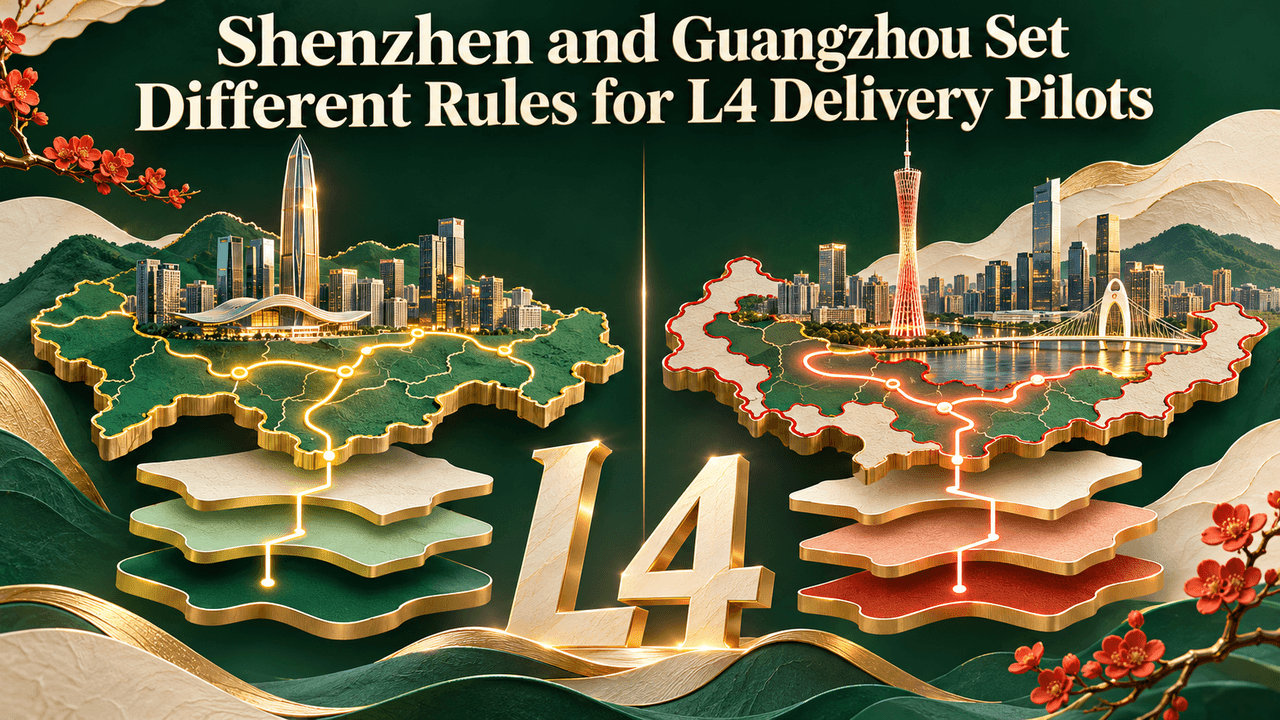
An L4 delivery proposal can cross a city boundary without changing its vehicle, cargo or customer. Its legal route may still change completely. In southern China, Shenzhen and Guangzhou have both opened space for automated freight, yet their rulebooks make different distinctions between an intelligent connected motor vehicle and a compact driverless delivery device. That distinction affects who receives the application, which tests count, what roads are available and when a trial can become a service. For an operator connecting a distribution centre to a parcel hub, the first regulatory question is therefore about the vehicle and the proposed movement, rather than the city’s reputation as an AV leader.
Shenzhen has a citywide vehicle track and district-level device experiments
Shenzhen’s special-economic-zone framework covers intelligent connected vehicles, including L4 motor vehicles. The city revised its road-test and demonstration-application rules in 2026. Its official explanation describes a four-level road classification based on traffic complexity, support for fully driverless testing and demonstration, and recognition of qualifying test results from elsewhere. The first application for driverless testing or demonstration can cover up to 50 vehicles under the revised rules. That ceiling does not itself approve 50 vehicles or turn a demonstration into unrestricted commercial carriage; the applicant still needs the relevant route and safety review.
Compact delivery devices may fall under another local process. Shenzhen’s Nanshan district introduced a two-year trial measure in February 2025 for low-speed electric vehicles without a driver’s seat or cab, including unmanned delivery vehicles. It requires one safety officer for each device. For an application pilot, a vehicle can qualify through at least 240 hours or 1,000 kilometres of local road testing without an at-fault crash; the measure also sets an alternative route for a vehicle with substantial comparable experience elsewhere plus local testing. Initial test or application-pilot requests are capped at 20 devices. These are Nanshan conditions for this equipment category, not citywide conditions for every L4 motor vehicle.
The distinction matters operationally. A van-sized road vehicle moving parcels between two hubs may follow the citywide motor-vehicle track. A smaller device carrying a few orders through Nanshan may be assessed under the district’s functional-vehicle measure. A logistics buyer should not choose one set of kilometre thresholds or vehicle caps based on the word “autonomous” alone.
Guangzhou puts equipment and vehicles in one municipal rulebook
Guangzhou’s September 2025 management measure expressly covers both intelligent connected cars and unmanned equipment. For cars, it distinguishes road testing, demonstration application, demonstration operation and commercial operation. For equipment, the dedicated chapter covers road testing and demonstration application. The stages are defined differently, so an equipment demonstration should not be described as an approved commercial transport operation merely because the same document also regulates commercial operation for cars.
The equipment path has a clear division of responsibility. The municipal road-test authority reviews test applications and issues a test notice and equipment code plate. A demonstration-application proposal goes to the relevant district body; a cross-district proposal is escalated for city-level review. Guangzhou also requires equipment applicants to show real-time monitoring, incident recording and response capacity. Before demonstration, the equipment model needs recognition under the measure, and operating data must feed the unified safety-monitoring platform. These details can affect fleet architecture as much as the road map does: the buyer needs monitoring and recovery arrangements that work across the proposed service area.
Map the delivery job before comparing permits
Imagine a postal operator moving sealed bags from a sorting site to three local depots. The route may begin on private premises, enter a public street, pass through a second district and finish at a depot gate. In Guangzhou, a cross-district equipment demonstration triggers a different review route from a single-district proposal. In Shenzhen, the applicant must first establish whether the proposed vehicle falls under the citywide L4 motor-vehicle rules or the district’s functional-device measure. A project team should then identify the exact road segments, turning points, supervision model and handover procedure before describing the run as postal delivery at scale.
The same discipline applies to evidence. A closed-course test can establish that a vehicle handles defined manoeuvres, but the public-road application must address the local traffic and loading context. A recurring service also needs predictable exception handling: a blocked loading bay, a failed handover, a communications gap or a temporary road closure. These are commercial questions as well as regulatory ones, because an approved route that cannot complete the actual customer handoff has little value.
A real freight route, with a separate permit
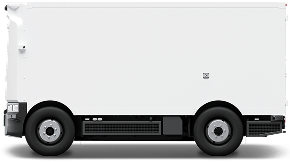
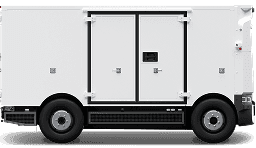
The Z5 RoboVan from Singapore-based Zelostech is presented for postal and express-delivery work, making it relevant to the kind of hub-to-customer movement considered here. The product description alone cannot determine whether a specific deployment in Shenzhen or Guangzhou would be classified as a motor vehicle or unmanned equipment, or whether a particular road would be approved. Those are local legal and technical findings for the proposed configuration.
The company does report a concrete Chinese public-road operation, but in Changzhou, not in either city discussed above. In a June 2026 announcement, Zelostech said DHL was using a Z5 on a dedicated route between its express service centre and a display-equipment customer’s production site. The company reported public-road authorisation, autonomous-driving operational approval and continuous commercial service, with a trip of approximately 38 kilometres. That example shows what a commercially useful approval can support: a defined freight movement tied to customer cut-off times. The reported permissions and operating figures belong to the Changzhou project; they do not authorise another vehicle, route or city.
For a buyer choosing between Shenzhen and Guangzhou, the practical comparison is therefore specific. Shenzhen’s vehicle rules and Nanshan’s device trial ask different questions; Guangzhou’s municipal measure makes equipment testing and demonstration procedures explicit. The next step is to place the intended cargo route and vehicle category against the applicable local process, then decide whether the available approval stage matches the service being sold. That is a more reliable starting point than a headline about a city “opening up” to L4 delivery.