Thailand’s L4 Vehicle Tests Move onto Rayong’s Industrial Roads
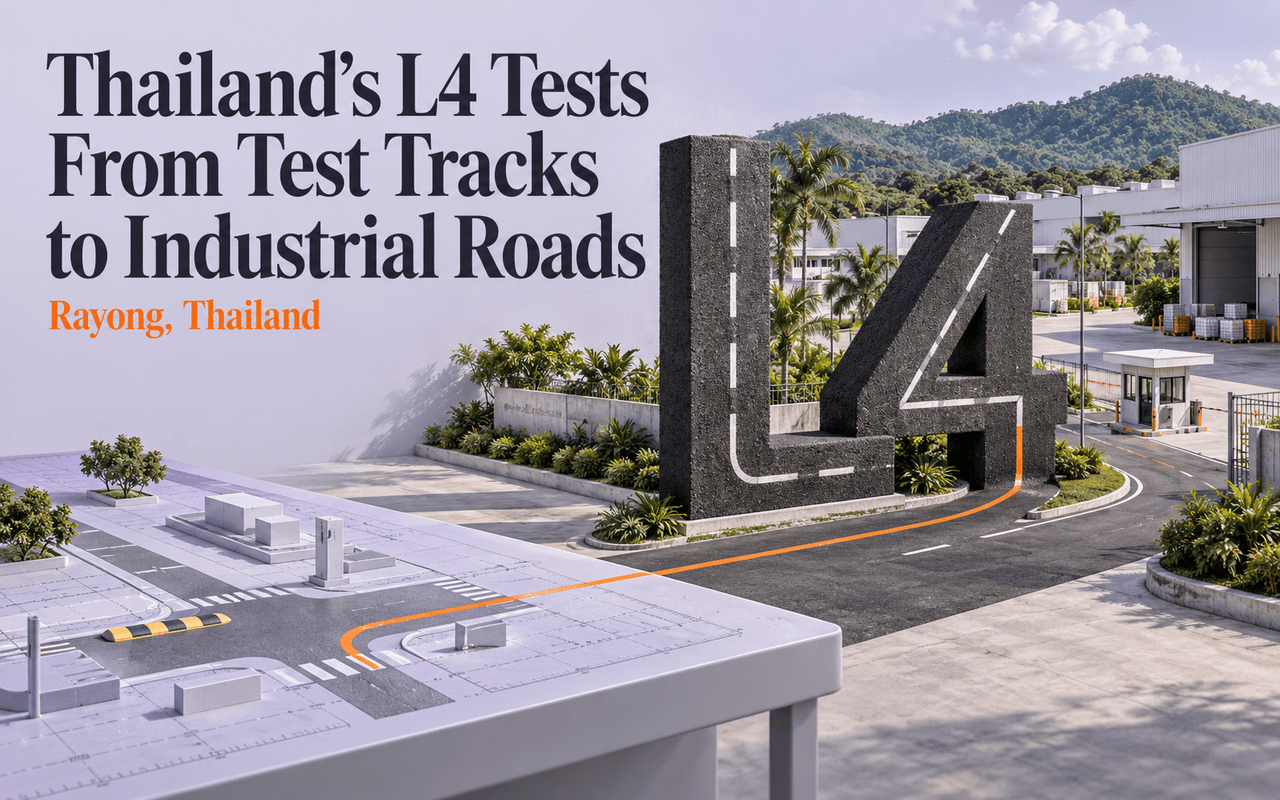
In Rayong, L4 logistics testing has moved from structured scenarios at a dedicated centre to roads inside a working industrial estate. The second setting introduces ordinary vehicles, loading traffic and site access decisions that a scripted exercise cannot fully reproduce. For a warehouse or manufacturer considering a similar route, the question is what each stage can establish—and which permission is still needed before goods move as a regular service.
Thailand has active testing infrastructure and a developing regulatory approach. It does not yet offer a single, general L4 delivery licence that turns a successful track test into permission to run unattended freight vehicles across public roads. Rayong shows why the site boundary, the legal basis for testing and the planned transport task have to be examined together.
The test-vehicle rule, and its limits
Thailand’s Department of Land Transport (DLT) has a 2017 notification on vehicles used for testing. It distinguishes pre-production tests from quality tests and provides for an application, permission period and identifying mark. Manufacturers, importers, developers, government bodies and academic institutions are among the eligible applicants. This is a vehicle-testing mechanism, rather than a complete set of rules for a driverless goods service. An operator should establish which vehicle category, test purpose and road conditions its particular project falls under before treating any test permission as relevant.
Thailand’s broader autonomous-driving framework is still developing. A 2025 policy study found that existing road-traffic and motor-vehicle laws do not specifically address autonomous vehicles, while the government reported in 2026 that DLT was studying a dedicated regulatory framework and testing sandbox. Those initiatives point toward more tailored rules, but they should not be treated as an enacted nationwide L4 operating regime.
For a freight operator, the distinction changes the sequence of work. A test at a controlled facility generates evidence about how a vehicle responds to planned situations. Permission to use a particular industrial road, interact with other traffic or provide a regular transport service raises different questions about site control, incident handling and the responsible operator. An industrial-estate arrangement does not automatically cover neighbouring public roads.
Two Rayong settings with different risks
Rayong brings several kinds of testing together. The Eastern Economic Corridor of Innovation describes its Wangchan Valley facilities as a regulatory sandbox with a connected-and-autonomous-vehicle proving ground. A proving ground allows repeatable safety exercises. It cannot, by itself, show what happens at a warehouse gate when a motorcycle crosses a vehicle’s path or a truck temporarily blocks a lane.
The Ministry of Higher Education, Science, Research and Innovation reported a Level 4 testing session at the T-CAVs facility in September 2026 as part of work on policy recommendations. The team prepared mapping for both the test centre and WHA Eastern Seaboard Industrial Estate (ESIE). Its observations included stop-sign behaviour, speed bumps, roadside parking and vehicles exceeding speed limits. These are exactly the kinds of local conditions that a logistics route assessment must account for; a vehicle cannot assume that every other road user follows a scripted test.
WHA ESIE provides a second, distinct environment: roads inside an active manufacturing and logistics estate. The move from facility scenarios to industrial traffic is a useful progression, but neither location should be described as a nationwide pilot zone or a general public-road authorisation. Each project’s actual boundaries and permissions matter.
Zelostech’s move onto industrial roads
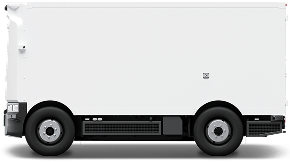
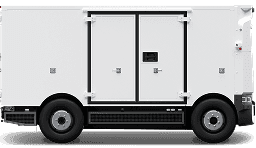
The ministry identifies Zelostech’s Z5 RoboVan among the models used in the September tests. Its report covers more than 20 designed edge-case scenarios, including interaction with other road users and access control. That supplies a useful baseline for subsequent testing, although performance on a test course cannot establish service reliability in a live freight network.
According to Zelostech’s October 2026 account of its Rayong programme, the Singapore-based company then tested an L4 autonomous logistics vehicle at WHA ESIE among regular industrial traffic. The company describes this as testing in a real operating environment, following the structured T-CAVs work. The programme remains a testing and validation effort rather than a general public-road commercial deployment. That stage distinction matters for any business evaluating the evidence.
The industrial setting makes the next questions unusually concrete. Can the vehicle negotiate a blocked approach without disrupting other site traffic? Who confirms that goods are ready and that the receiving bay is clear? What happens if work on a factory access road changes the planned route? Those questions connect automated driving to shift schedules, site access rules and human handovers. They also explain why mixed-traffic testing adds value beyond repeating more track manoeuvres.
What a commercial L4 logistics route must prove
A prospective operator should start with a repeatable task in industrial park logistics: moving components between a warehouse and a production building within an estate. The route’s road status, physical boundary and controlling authority determine which permissions and site agreements need checking. Traffic composition matters just as much. A short journey that crosses loading queues several times may demand more intervention planning than a longer, quieter connection.
The operational record should then answer a narrow set of questions: how often was a trip completed as scheduled, which events required help, how was the vehicle recovered, and did dispatch and receiving teams have to change their workflow? These are proposed evaluation measures, not results claimed for the Rayong trial. They help a shipper decide whether automation can fit an existing service window and what evidence would support a later request to extend the route.
Rayong shows a clear progression from controlled L4 testing to validation on working industrial roads. That does not yet amount to a general commercial operating licence, but it provides more relevant evidence for logistics deployment. For operators, the next step is to show that a defined route can operate reliably under the applicable permissions, traffic conditions and cargo-handling requirements