The Infrastructure of the Autonomous Age
April 21, 2026
Share this article:
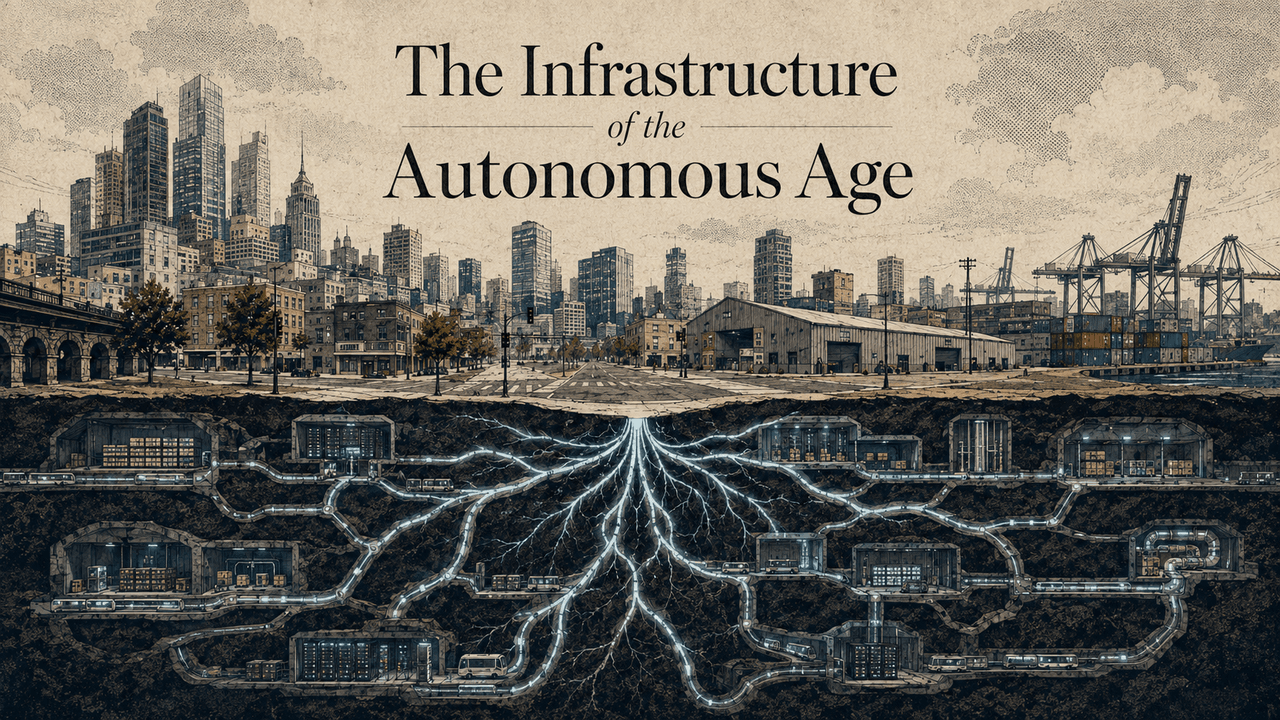
Infrastructure has long been understood in physical terms. Roads, ports, railways, and warehouses form the visible skeleton of economic life, shaping how goods move and how cities grow. Yet across each industrial transition, infrastructure has expanded beyond its material form. It has come to include the systems of coordination, timing, and information that allow movement to occur with greater precision. The next phase of this evolution is not defined by a single technology, but by the convergence of systems that bring intelligence into the structure of movement itself.
The Shift from Vehicles to Systems
Autonomous mobility is often described in terms of vehicles, but its significance lies elsewhere. What is emerging is not simply a new type of machine, but a broader ecosystem in which movement is coordinated through layers of sensing, computation, and communication. Vehicles become nodes within a larger system that includes perception technologies, artificial intelligence, energy management, and digital infrastructure.
In this context, the unit of analysis shifts. The performance of any single vehicle matters less than the behavior of the system as a whole. Routes are no longer fixed paths but dynamic processes shaped by real-time conditions. Movement is guided not only by physical constraints, but by continuous interpretation of the environment. Infrastructure begins to extend beyond roads and networks into the domain of intelligence, where coordination itself becomes a central function.
Integration with Cities
As this system develops, it does not remain separate from the city, but becomes increasingly embedded within it. Logistics networks are already closely tied to urban form, shaping how goods enter, circulate, and exit dense environments. With greater levels of coordination, these networks may begin to align more closely with urban planning and daily rhythms of activity.
Movement can be distributed with greater sensitivity to time and place. Demand patterns can be anticipated rather than simply reacted to. The boundaries between infrastructure and operation begin to blur, as cities are not only served by logistics systems but gradually shaped in relation to them. Autonomous mobility does not sit on top of the city, but becomes part of how the city organizes itself.
Global Implications
This transition will not unfold uniformly. Different regions will adopt autonomous infrastructure at different speeds, shaped by regulatory environments, labor conditions, urban density, and economic priorities. Some cities may move quickly toward integrated systems, while others evolve more gradually through partial adoption.
These differences do not imply fragmentation, but variation in pathways. Just as previous infrastructure revolutions took distinct forms across regions, the autonomous age will reflect local conditions while contributing to a broader global shift. Over time, patterns of adoption may begin to converge, not through uniformity, but through shared pressures toward efficiency, safety, and sustainability.
A Long-Term Perspective
Seen over a longer horizon, autonomous logistics is part of a wider transformation in how infrastructure is conceived. Movement is no longer defined solely by physical capacity, but by the ability to coordinate that capacity with greater awareness. Intelligence becomes embedded in the system, shaping how resources are allocated and how cities respond to demand.
This marks a continuation of previous logic rather than a break from earlier forms of infrastructure. Each phase has sought to reduce friction in the movement of goods, expanding the scale at which economies can operate. The difference now lies in the medium through which this is achieved. Where earlier systems extended reach through physical networks, emerging systems extend capability through coordination.
The infrastructure of the autonomous age will therefore be measured not only by what is built, but by how effectively movement is understood and guided. It is a shift from static networks to responsive systems, from fixed routes to adaptive flows. As with previous transformations, its significance will become most visible not in its novelty, but in the degree to which it becomes an ordinary, sustaining part of how cities and economies function.