The Pace of Change
May 26, 2026
Share this article:
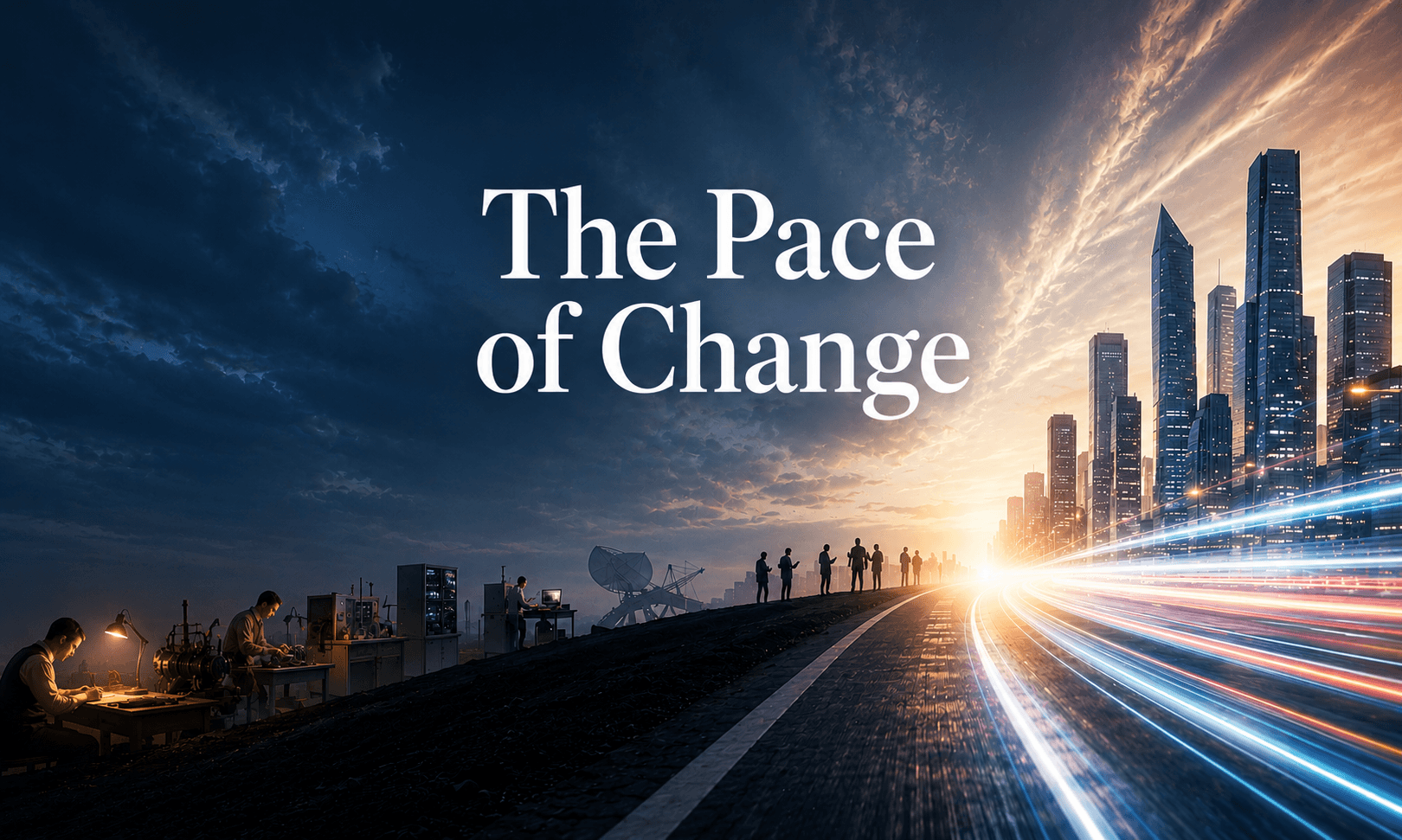
The Illusion of Sudden Change
History repeatedly produces this effect. Railways, electricity, automobiles, and the internet are often remembered as breakthroughs that rapidly altered society. In practice, each emerged through long periods of refinement, infrastructure expansion, and uneven adoption. Early systems were expensive, unreliable, and limited in reach. Their eventual dominance compresses the memory of the slower years that came before.
Societies also perceive change unevenly. Incremental developments rarely attract sustained attention. A technology may exist quietly for years before suddenly becoming visible across daily life. By the time the public notices it, much of the underlying work has already been completed.
Gradual Accumulation
Most technological development advances through repetition rather than singular invention. Systems improve through countless small adjustments. Costs decline gradually. Infrastructure expands in fragments. Reliability increases through accumulated operational experience.
Much of this process unfolds outside public awareness. Development continues quietly beneath the surface, shaped by engineering iteration, financial investment, and the slow coordination of industries adapting to new capabilities. A single improvement rarely changes society on its own. The larger transformation emerges from accumulation.
At a certain stage, these accumulated improvements begin to reinforce one another. Systems become stable enough for broader adoption. Infrastructure reaches sufficient density. Technologies that once felt experimental begin to integrate into ordinary routines. This is often the moment when change appears to accelerate. Yet the apparent speed of transformation can be misleading. The visible transition is usually the final phase of a much longer developmental process.
The spread of automobiles followed decades of industrial expansion, road construction, and manufacturing refinement. The rapid growth of the internet in the late twentieth century rested on communication systems and computational research that had evolved for years beforehand. What appears sudden is often the moment when long preparation becomes socially visible.
Social Perception and Adaptation
Periods of technological transition often produce anxiety because familiar structures begin to shift faster than institutions can adapt. Public attention tends to focus on immediate disruption, particularly around labor, privacy, and social stability. Societies gradually reorganize themselves around new conditions. Legal systems evolve, industries restructure, and cultural expectations change over time. Technologies that initially feel disruptive often become ordinary parts of everyday life within a generation.
The process is rarely smooth or evenly distributed. Different regions, industries, and social groups adapt at different speeds. Technological transitions are therefore experienced unevenly, even when the underlying systems are global in scale.
Continuity Beneath Change
Even moments of major transformation contain strong elements of continuity. New technologies rarely replace entire systems outright. More often, they extend existing infrastructure and reorganize patterns that already exist. Railways expanded older trade networks. Automobiles reshaped cities built around earlier forms of transportation. Digital systems accelerated flows of information that had been developing for centuries.
Current developments in artificial intelligence, autonomous systems, and advanced logistics reflect a similar pattern. Their effects may appear sudden, yet they emerge from long periods of industrial, computational, and infrastructural development.
The pace of change is therefore partly a matter of perception. Technologies often evolve gradually until their effects become visible all at once. What feels revolutionary in a given moment is usually the product of processes that unfolded quietly beforehand