The Silent Crisis of Urban Logistics
May 12, 2026
Share this article:
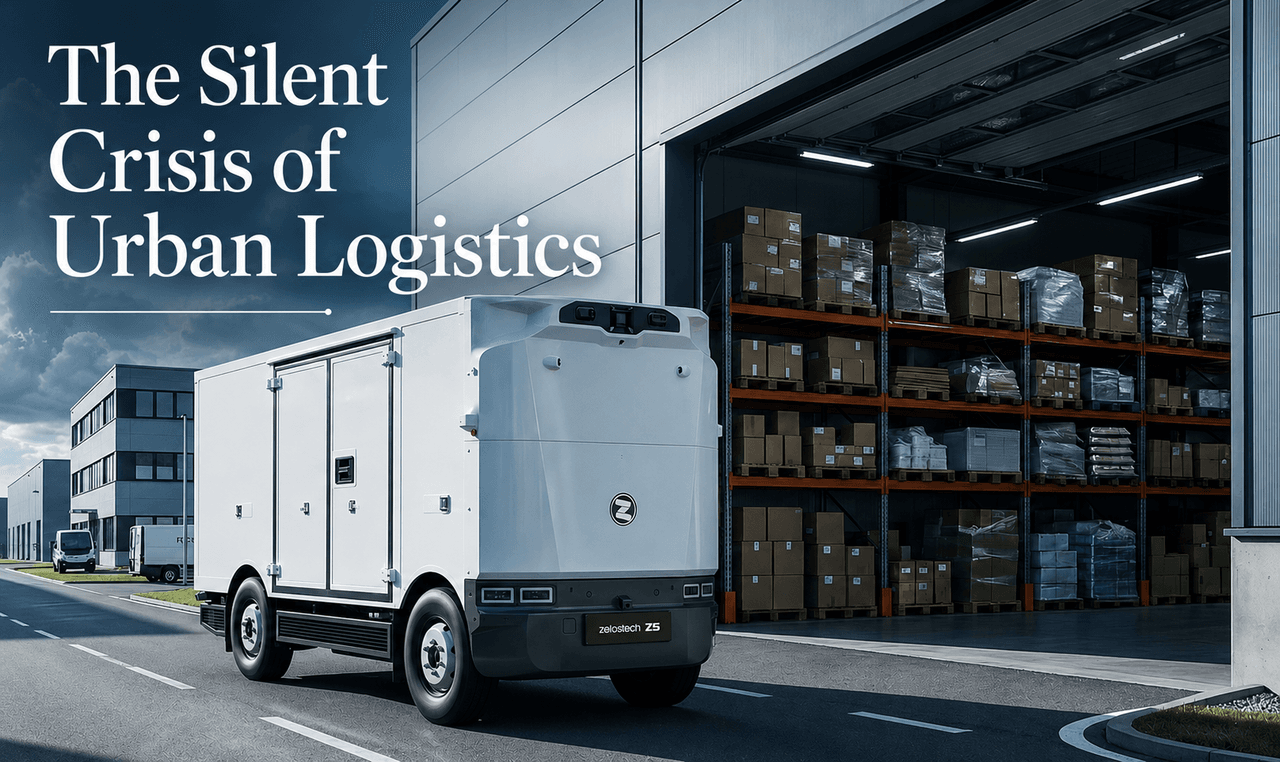
Modern cities are under growing pressure from a system most people rarely notice. Every day, millions of deliveries move through urban environments with an expectation of speed, continuity, and invisibility. Packages arrive within hours, shelves remain stocked, restaurants receive supplies before opening, and industrial systems continue operating without interruption. The modern city depends on this circulation so completely that its absence is often easier to imagine than the infrastructure that sustains it.
Yet beneath this convenience lies a growing strain. Urban logistics networks are carrying far more movement than they were originally designed to support. E-commerce, on-demand services, and fragmented supply chains have transformed the rhythm of movement within cities. What was once concentrated into scheduled deliveries and centralized distribution has become a near-continuous flow operating across every hour of the day.
The result is visible in subtle ways. Delivery vehicles occupy already congested streets, repeat overlapping routes, and compete for limited urban space. Traffic density increases gradually rather than dramatically, accumulating through repetition. At the same time, logistics systems face mounting structural pressure from labor shortages, aging workforces, rising operational costs, and increasing demand for faster fulfillment.
These challenges are not isolated inefficiencies. They reflect a deeper mismatch between the scale of modern urban demand and the systems currently responsible for sustaining it.
Much of today’s logistics infrastructure was built for an earlier era of movement. It was designed around predictable delivery schedules, lower order volumes, and slower rates of circulation. Modern cities now operate under very different conditions. Movement has become more fragmented, more dynamic, and more difficult to coordinate through traditional methods alone.
We believe this is where the next phase of logistics infrastructure begins.
At Zelostech, we view autonomous mobility not simply as a vehicle technology, but as part of a broader transition toward more intelligent systems of movement. The challenge facing cities is no longer only how to move goods from one location to another, but how to coordinate movement at a scale and complexity that human-operated systems increasingly struggle to sustain efficiently.
Our work in autonomous logistics is shaped by this understanding. Through large-scale real-world deployment, we have focused on building systems capable of operating continuously within the unpredictability of real urban environments. This includes complex intersections, dynamic traffic conditions, dense industrial zones, and the countless small irregularities that define everyday city life.
The significance of autonomy, in our view, lies less in automation itself than in coordination. Autonomous systems are capable of responding to real-time conditions, optimizing movement dynamically, and reducing many of the inefficiencies that accumulate across fragmented logistics networks. Routes can adapt continuously. Fleet operation becomes more stable. Repetitive movement can be handled with greater consistency and lower operational strain.
This shift carries broader implications beyond efficiency alone. More intelligent logistics systems can reduce unnecessary circulation, improve energy utilization, and ease pressure on both infrastructure and labor systems. In cities already struggling with congestion and environmental stress, these improvements become increasingly important.
We do not see autonomous logistics as a sudden replacement for existing systems, but as part of the long evolution of infrastructure itself. Throughout history, major transformations in transportation have reshaped the scale at which cities and economies could operate. Railways connected industrial regions. Highways reorganized urban growth. Containerization transformed global trade. Today, intelligent mobility systems may represent the next stage in that progression.
The silent crisis of urban logistics is ultimately a problem of coordination at scale. As cities continue to grow, the systems that sustain them must become more adaptive, more resilient, and more aware of the environments in which they operate.
At Zelostech, we believe the future of logistics will depend not only on moving goods faster, but on moving them more intelligently.