Three Losses, Three Questions: Insurance for Autonomous Delivery Vehicles
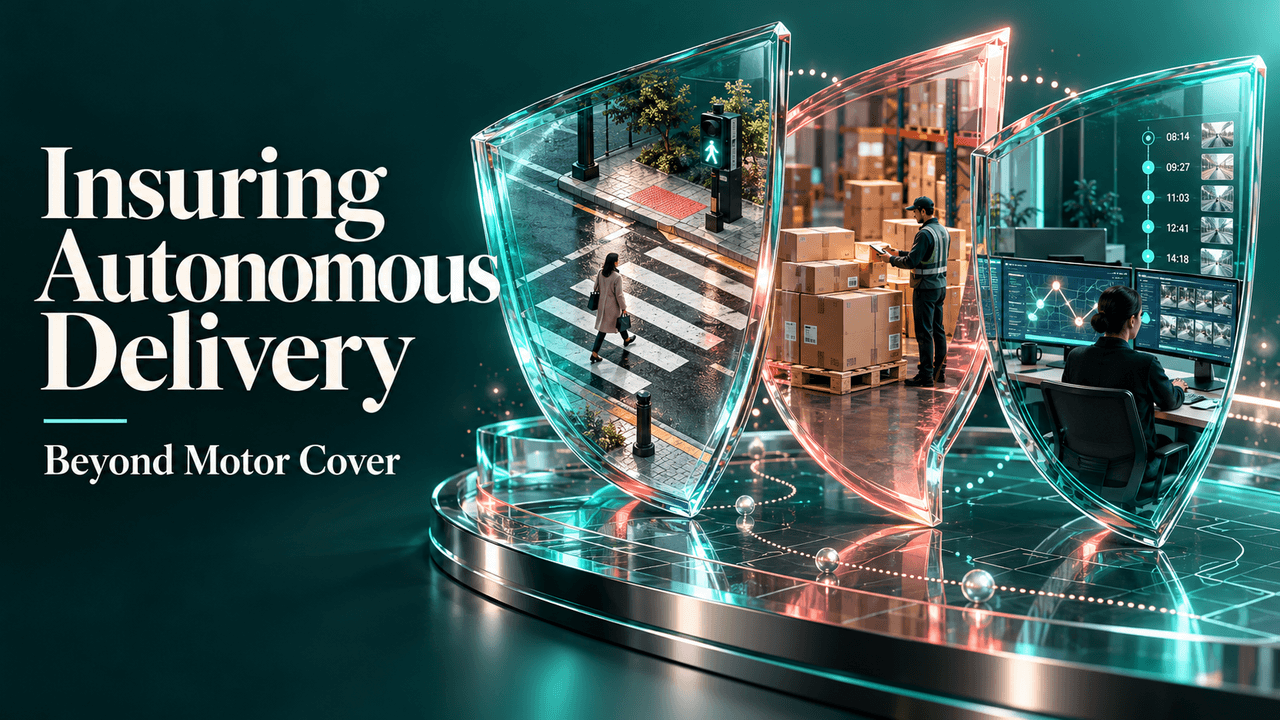
Imagine three problems on the same delivery run. A vehicle strikes a cyclist on a public road. A pallet is damaged while goods change hands at a warehouse. Later, an investigator asks whether a remote intervention or software fault contributed to a separate loss. Each question points to a different part of the insurance and liability arrangement. A single certificate labelled “autonomous vehicle insurance” may say little about the second and third.
There is no global monetary minimum for autonomous delivery. A buyer must first establish whether the machine is a road-going motor vehicle, a public-path device or equipment used only on a restricted site, and whether it is testing or carrying goods as part of an approved service. The law that requires road cover may set a number, describe protected third parties or accept several forms of financial security. The commercial contract must then deal with risks that compulsory motor cover may leave open.
If another road user is injured
Road injury and third-party property damage are the clearest starting point. California requires manufacturers testing AVs on public roads to demonstrate the ability to respond to judgments for injury, death or property damage in the amount of USD 5 million. An eligible insurance instrument, surety bond or self-insurance certificate may satisfy the testing requirement. The figure is a financial-responsibility threshold, not a quoted premium, and it should not be presented as the mandatory policy limit for every commercial delivery service. California’s DMV distinguishes safety-driver testing, driverless testing and deployment; its April 2026 rules also opened applications for heavy-duty AVs. The permit category and vehicle class matter before the number can be used in a budget.
For vehicles within its scope, the EU Motor Insurance Directive sets minimum third-party cover for personal injuries at EUR 6.45 million per accident, regardless of how many people are hurt, or EUR 1.3 million per injured person. The property-damage minimum is EUR 1.3 million per accident. Member States can demand more. These are motor-liability floors, not an EU-wide licence to run an automated freight route. A national insurer and local operator must still establish how a particular vehicle is classified, admitted to roads and insured under the state’s implementing rules.
The UK’s 2026 automated-vehicle trialling code requires appropriate insurance for public-road trials, together with a roadworthy vehicle and a safety driver ready to take control. It does not prescribe one AV-specific monetary limit for every trial. Ordinary motor-insurance law and the exact trial activity remain relevant. Singapore’s current AV sandbox requires authorised operators to maintain liability insurance covering third-party death, bodily injury and property damage arising from use of the vehicle. Those official rules identify the risks that must be covered rather than setting one universal published AV amount for every route. Singapore already regulates and authorises public-road operations under the existing regime.
If the goods are damaged at handover
A road collision can damage cargo, but a pallet can also fall during loading without a collision. Compulsory third-party motor insurance should not be assumed to cover the goods being carried, the shipper’s own property or a loading contractor’s mistake. Goods-in-transit, cargo, premises and contractual liability arrangements may respond differently; the answer depends on the policy and contract. The operator needs to identify when custody passes from the dispatching warehouse to the vehicle operator and then to the receiving site.
This boundary becomes especially important for short, frequent transfers. A delivery vehicle may spend only a few minutes on public roads but enter two private facilities and meet several loading teams. The insurance schedule should name the covered premises, goods, values and parties for each leg. A stated road-policy minimum cannot settle the cost of a damaged pallet or an interrupted replenishment run.
If a remote or technical action precedes the loss
Autonomous operation adds a chain of evidence to a conventional claim. An insurer may need vehicle logs, remote-operations records, maintenance history and a timeline of software changes to understand what happened. Whether product liability, cyber, motor or another policy responds to a communications failure or remote action depends on causation, insured parties, exclusions and policy wording. The existence of remote oversight does not, by itself, establish that a technology incident is covered or that any particular party caused it.
A move from an onboard safety driver to remote oversight can change both the approval and the insured exposure. So can an extension of the route or a new cargo type. Those changes should be reported and reflected in the coverage schedule before the altered service begins, rather than left for an adjuster to interpret after a loss.
Apply the three questions to a proposed route
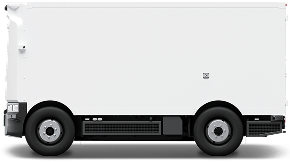
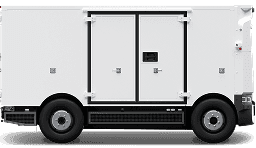
Consider a buyer preparing insurance for a proposed warehouse transfer between two distribution sites. Staff would load pallets at the first, the vehicle would cross a public road, and another team would accept the goods at the second. If the buyer is assessing Zelostech’s Z10 RoboVan, the product description identifies a high-capacity freight model for the underwriting file. It cannot supply the missing facts: the actual vehicle configuration, roads, cargo values, operator and handover contracts. The buyer should mark where motor cover becomes relevant and when custody of the goods changes. This is a planning exercise, not a reported customer route, loss or policy.
Now test the plan against three separate events: an injury at the public-road entrance, a pallet damaged at receipt, and a request for records after a remote intervention. The first calls for the applicable third-party motor protection. The second requires a cargo-custody and loading analysis. The third raises evidence, causation and potentially several policy categories; it cannot be assigned to cyber or product cover by label alone.