What 100 Million Kilometers Reveal About Cities
April 7, 2026
Share this article:
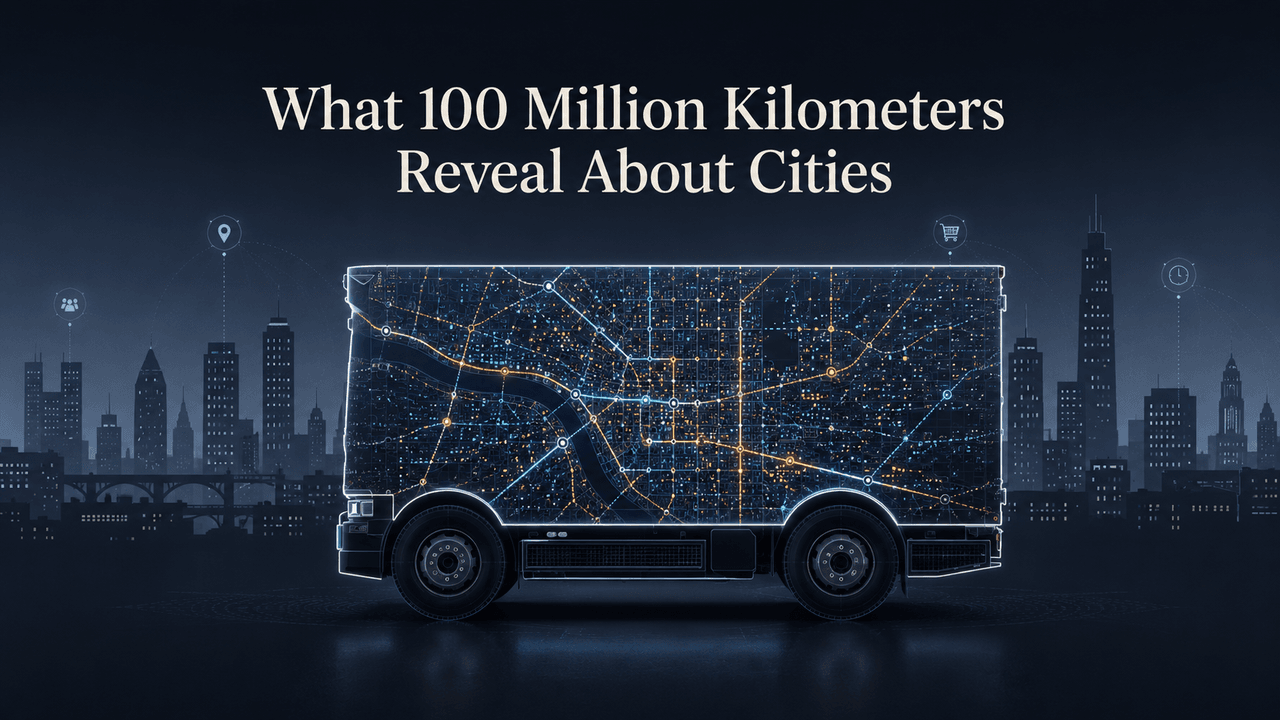
Cities are often understood through their visible forms: skylines, streets, districts, and infrastructure. Yet much of what defines urban life lies in patterns that are harder to see directly. Movement reveals these hidden structures. Much like urban desire paths, repeated autonomous routes reveal how cities are functionally inhabited rather than merely designed. The repeated circulation of vehicles through the same roads, intersections, industrial zones, residential neighborhoods, and commercial corridors gradually forms a different kind of map, one shaped less by design than by lived function.
At a sufficient scale, autonomous mobility offers a uniquely continuous perspective on this reality. What emerges from long-term operation is a deeper understanding of how cities organize demand, absorb pressure, and sustain their daily rhythms.
What Large-Scale Operation Reveals
Operating autonomous vehicles at scale produces a form of urban observation that is difficult to replicate through static infrastructure or short-term studies. Each kilometer adds to a growing body of real-world experience shaped by weather, road conditions, traffic behavior, delivery demand, and the subtle irregularities of city life. Over time, these accumulated encounters reveal the city less as a fixed physical environment and more as a dynamic system of recurring patterns. Through sustained research and observation, cities turn into a living, breathing lifeform.
At this level of repetition, the value of scale lies in what begins to stabilize across variation. Certain intersections consistently generate friction. Particular districts display predictable rhythms of demand. Road environments that appear similar in design may behave very differently in practice. Large-scale autonomous operation transforms movement into a continuous process of urban reading, where the city gradually discloses its operational logic through repetition, exception, and return.
Patterns of Movement in Cities
Over time, logistics routes begin to reveal the city in ways that conventional maps cannot. Streets that appear equivalent in physical form often carry very different economic meanings once observed through repeated movement. Certain corridors pulse with commercial intensity at specific hours, while others serve as quiet connective tissue between residential life and industrial activity. The circulation of goods traces the city’s underlying metabolism, showing where demand concentrates, where congestion forms, and how urban functions relate across space.
These recurring routes also illuminate the relationship between infrastructure and behavior. Traffic flow is shaped as much by habit and local practice as by formal road design. A turn that appears efficient in theory may repeatedly cause delays. A seemingly minor road may prove central to neighborhood distribution. Through sustained operation, movement becomes a form of urban interpretation, revealing how cities are actually used rather than simply how they are planned.
Engineering Lessons
This accumulated experience also reshapes the engineering understanding of autonomous systems themselves. Operating in complex urban environments exposes systems to the full range of ambiguity present in real cities: irregular driver behavior, shifting road conditions, temporary obstacles, and the unpredictability of human movement. It is within this constant negotiation with the real world that safety and reliability are refined.
What improves through scale is not merely technical performance, but the system’s capacity for judgment under variation. Repeated exposure to subtle anomalies and changing environmental conditions strengthens the relationship between perception, planning, and control. Reliability emerges through lived repetition. Safety becomes less a fixed benchmark and more the outcome of systems that learn to remain stable under the ordinary complexity of city life.
A New Form of Urban Intelligence
At a certain scale, autonomous mobility begins to generate something beyond operational efficiency. It produces a new form of knowledge about the city itself. The continuous reading of routes, demand, timing, friction points, and environmental variation creates an evolving understanding of how urban systems behave in practice. This is a form of intelligence grounded in movement rather than abstraction.
Such knowledge carries implications beyond logistics. It offers insight into how cities allocate space, where infrastructure is under strain, and how patterns of daily life shift over time. In this regard, autonomous mobility systems do more than move through the city. They become instruments through which the city can be more deeply understood, revealing forms of urban knowledge that emerge only through long-term, large-scale interaction with the rhythms of everyday life.