Why Cross-Docking Plans Break Down Between Arrival and Departure
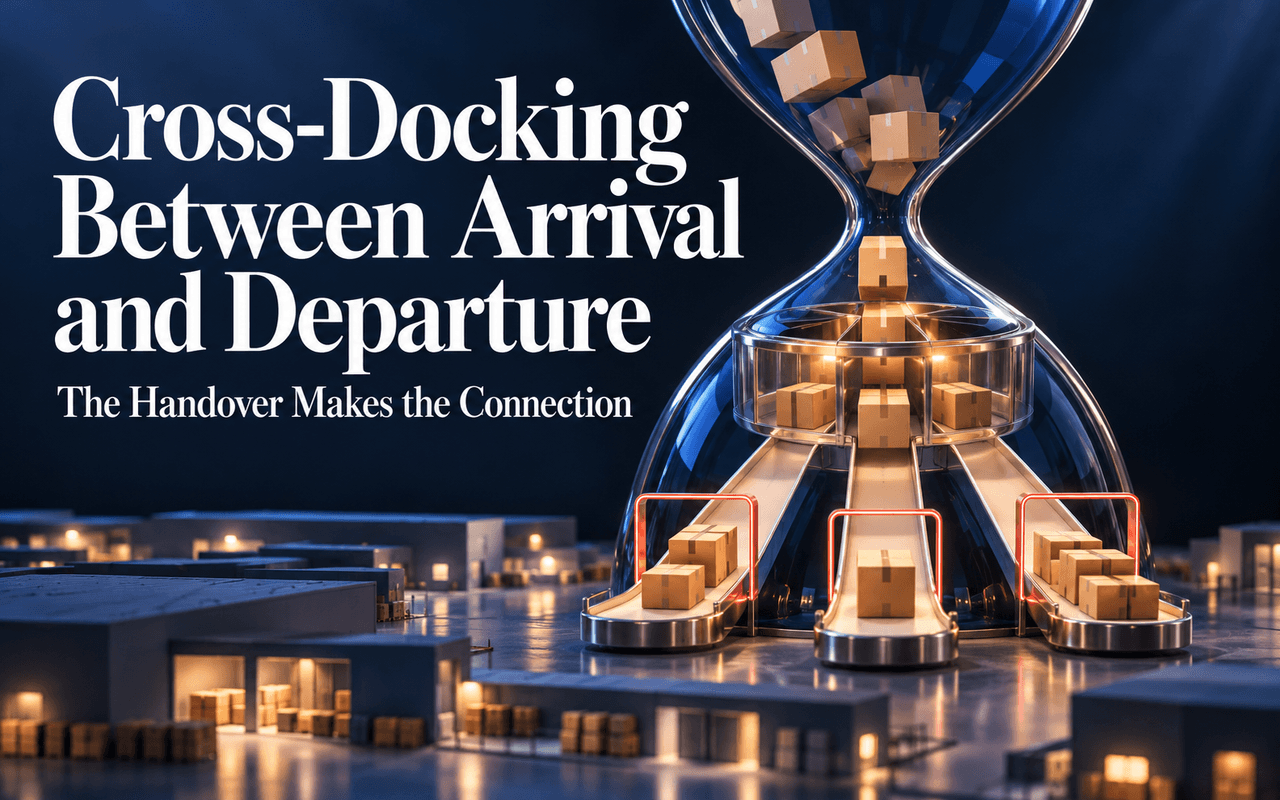 An inbound vehicle reaches the warehouse before the outbound vehicle leaves. The transfer should work. Yet some cartons are still being checked when the departure team closes the load, and the goods miss their connection. Both vehicles can be on time while the shipment arrives late.
Cross-docking in logistics depends on the work between those two movements. Goods pass through receiving, identification, sorting and a short staging period instead of entering a normal storage and picking cycle. Each step consumes time, space and attention. Scheduling only the arrival and departure leaves the connection largely unplanned.
Consider an illustrative shipment of 120 cartons split across three outbound tasks. The useful question is whether each group can become ready before its own loading cutoff. The warehouse needs a plan for that transition, including what happens when the expected goods and the received goods differ.
Cross-docking in logistics starts with an outbound commitment
Before accepting the inbound booking, identify the destination, quantity and departure task for each group. In this example, 50 cartons belong to route A, 40 to route B and 30 to route C. Their loading cutoffs are 09:00, 09:15 and 09:30 respectively; each vehicle departs fifteen minutes later. These are planning assumptions, not industry standards.
An advance shipment notice should connect the incoming load to those allocations. Useful information includes shipment references, carton or handling-unit identifiers, expected quantities and any receiving requirements. If one pallet contains goods for several departures, the team needs to know before it reaches the sorting area.
For warehouse transfer, the receiving team should distinguish arrival at the gate from availability for sorting. Check-in, access to a receiving position and unloading can consume much of the apparent connection time. A vehicle ETA alone cannot tell the outbound team when its goods will be ready.
Work backwards from each cutoff. Allow time for counting reconciliation, separation, movement to the correct staging position and final loading checks. Use observed handling times for comparable loads, and retain a realistic allowance for variation. A plan that needs every activity to finish at its fastest recorded speed will fail on ordinary days.
Follow the cartons through the connection
The timeline below assumes the shipment is correctly labelled and the planned people and handling equipment are available. It shows how a single inbound load becomes three distinct outbound consignments. The times illustrate a workable sequence; another facility will need different allowances.
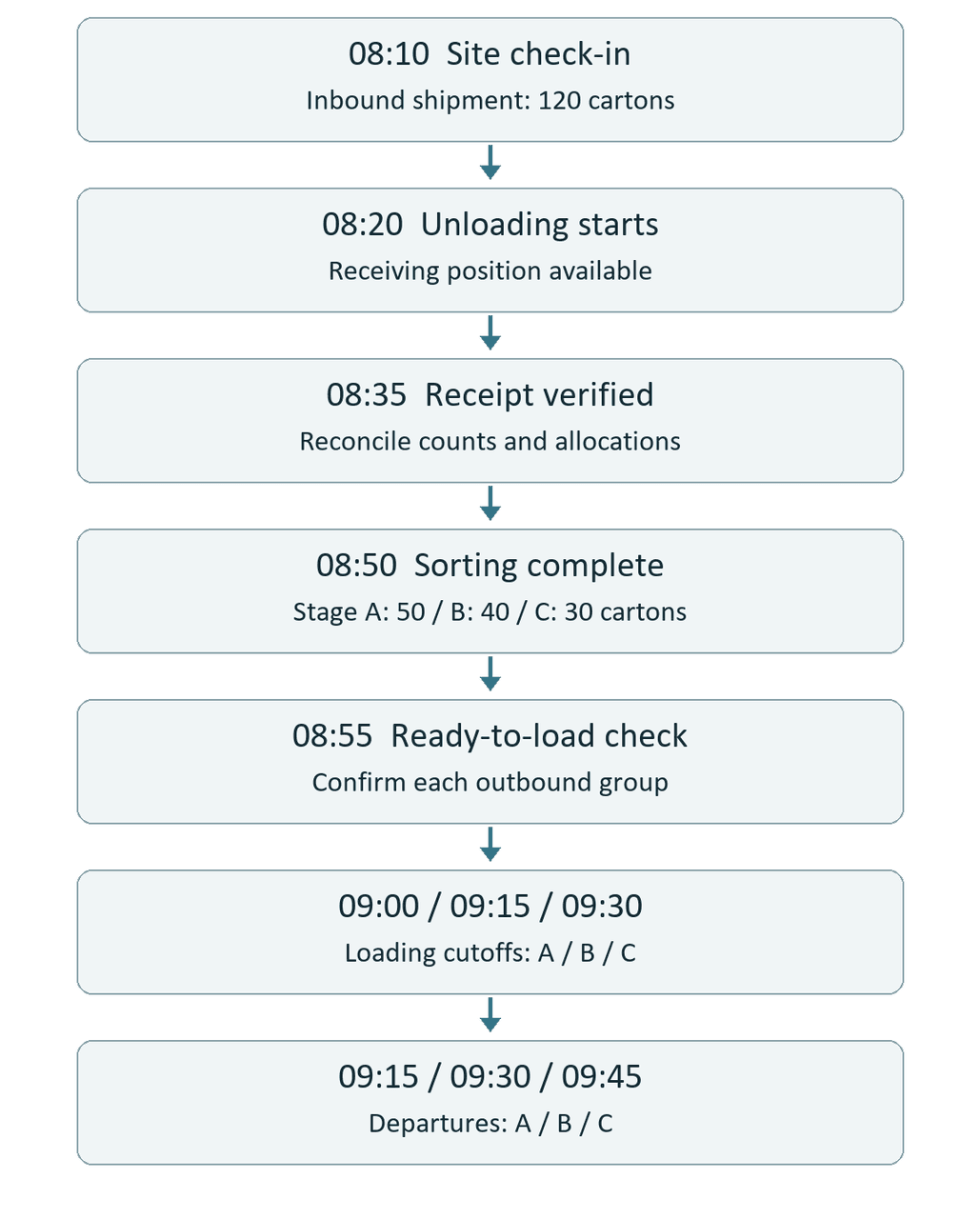
The 08:55 readiness decision matters more than the inbound vehicle's arrival message. At that point, the team confirms what is physically present in each staging position and whether any discrepancy prevents release. Goods labelled for route A but still sitting in an unresolved receiving area cannot count as ready for its 09:00 cutoff.
Keep the staged groups visibly separate. A staging position should identify its departure task and hold only the goods allocated to it, unless the local process explicitly supports shared space with reliable identification. The short dwell time associated with cross-docking can otherwise encourage informal piles that become difficult to reconcile during a busy wave.
Loading confirmation then links the actual cartons to the outbound movement. Close the inbound allocation only when its destination is known: loaded, held for investigation or reassigned. Recording the entire shipment as transferred when only two groups have left hides the third group's problem from the next shift.
Decide which connections to protect when arrival slips
Suppose the inbound vehicle reaches its unloading position at 08:40 instead of 08:20. Moving every downstream timestamp twenty minutes later would put route A's goods past its loading cutoff. Dispatch needs a decision while there is still time to change work, rather than a missed-connection report after departure.
The receiving lead should estimate when each group can be ready. If labels allow route A's 50 cartons to be separated and checked first without compromising safe handling, prioritising that group may protect its connection. If the load must be fully broken down before any destination can be verified, that option may be unavailable. Physical arrangement determines the recovery choices.
Holding route A's departure is another decision, with consequences for later receivers and the vehicle's next task. The transport planner should confirm an acceptable revised arrival before authorising a hold. Warehouse staff should not extend the departure simply because the remaining cartons are almost ready.
If six cartons for route B are missing, preserve the original expected quantity alongside the verified count of 34. The order owner decides whether a partial shipment is acceptable. Update the outbound manifest and remaining obligation separately; changing the expected total to 34 would make the shortage disappear from the record without resolving it.
Goods that miss their connection need an identified holding position, a responsible owner and a confirmed next movement. Avoid rolling them automatically into the next wave, which may already have committed capacity. A new task reference or explicit reassignment should preserve the link to the original shipment and customer promise.
Give the transport leg a clear release condition
An autonomous vehicle can take an outbound assignment, but the warehouse still has to establish that the assigned goods are ready. A useful release condition brings together a confirmed manifest, completed loading checks, a receiving destination that can accept the load and a valid transport instruction. Each confirmation should have an owner.
This boundary is relevant to the mixed-traffic warehouse movements described in the F&N deployment agreement. In August 2026, Zelostech announced that F&N would deploy Z10 RoboVans for cargo transport in Singapore warehouse environments. The announcement establishes the planned transport setting; it does not describe an F&N cross-docking process or its performance.
For a comparable operation, the Singapore-based company's Z10 RoboVan would be assessed against the released transport task. The integration question is specific: can the warehouse withdraw or revise a task before dispatch, and can the operator confirm which instruction is active? Those behaviours have to be agreed and tested in the proposed system rather than assumed from the vehicle’s autonomous capability.
Once loading has started, a change also affects physical work. Staff may need to remove a carton, correct the manifest and repeat relevant checks before a revised task is released. An updated screen should never be treated as proof that the actual load has changed with it.
Measure the handoff that caused the miss
Compare planned and actual timestamps for unloading access, receiving completion, staging readiness, loading completion and departure. These separate an unreliable inbound ETA from slow reconciliation, a congested staging area or an outbound vehicle arriving too late to load. Combining everything into average warehouse dwell makes the remedy harder to identify.
Review missed connections by carton group or consignment as well as by inbound vehicle. In the example, protecting routes A and C while delaying B is a different outcome from missing all three. Record the reason for the decision, the revised customer commitment and whether the remaining goods actually reached the next departure.
Cross-docking works when the facility can turn an expected inbound shipment into verified outbound loads within the available handling window. The connection becomes dependable when each carton group has a destination, each cutoff reflects the work that must happen before loading, and each missed connection has a defined recovery path.