Why Every Industrial Revolution Begins with Transportation
March 24, 2026
Share this article:
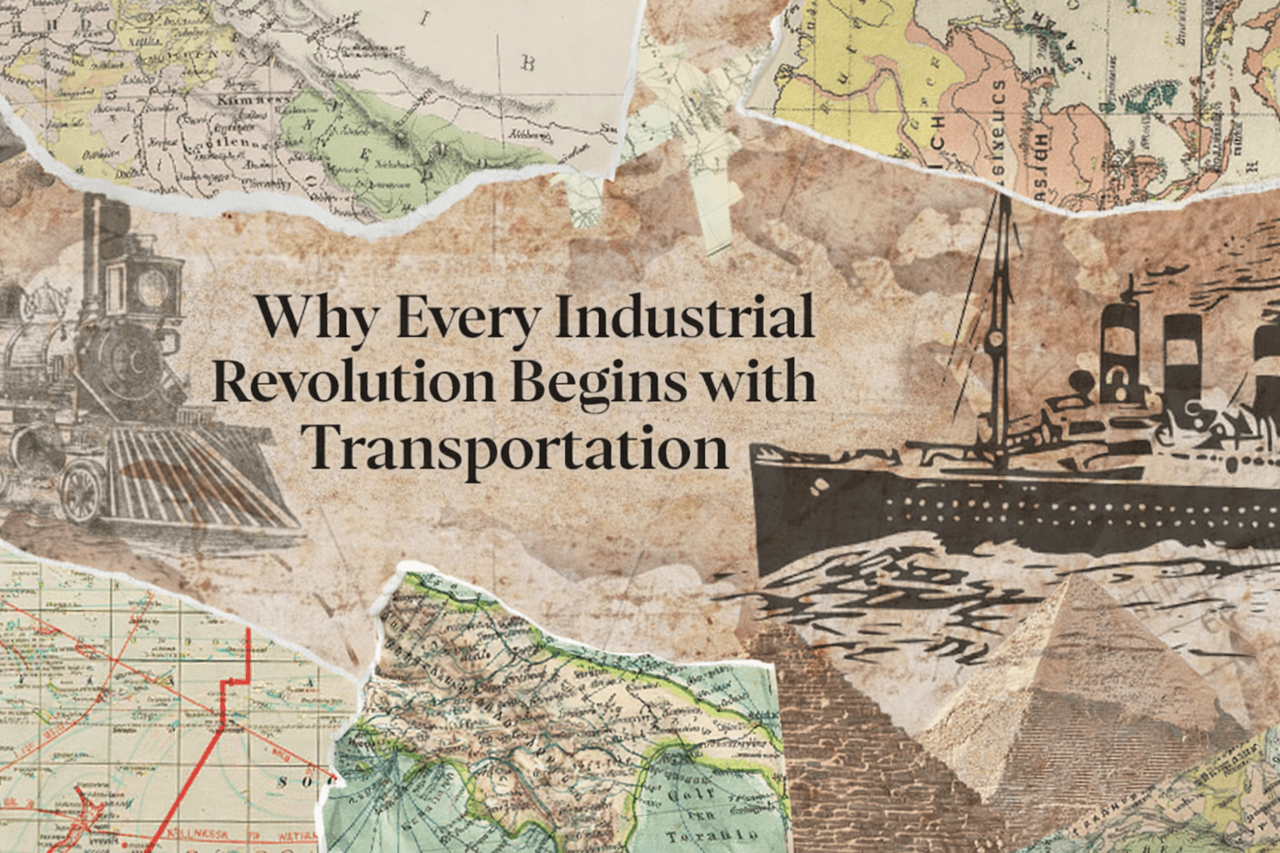
Transportation is where every industrial revolution truly begins. Before production can scale, before industries can expand, goods and people must first have the potential move farther and faster. Movement comes first, everything else follows.
The Evolution of Industrial Revolution
The first industrial revolution was not just about factories, but about connection. Canals enabled the large-scale movement of raw materials, but it was the railway that changed everything. Trains compressed distance and connected cities into unified markets. Railroads led to to standarized time and the widespread use of clocks. These advancements allowed production to scale further and further beyond local demand. The expansion of industries was due to improvements in distribution as much as to increases in production.
The second industrial revolution is often associated with electricity and assembly lines, but transportation again played a central role. The automobile reshaped how cities were built and how people lived. Highways expanded the reach of commerce, while the assembly line depended on efficient movement of parts and goods. Production and transportation evolved together, forming the foundation of modern industrial economies.
In the twentieth century, container shipping transformed the global economy. Standardized containers made it possible to move goods seamlessly across ships, rail, and trucks. This shift reduced friction in trade and enabled globalization at scale. It it less well known than earlier revolutions, but just as impactful. Supply chains became further and further interconnected.
The Next Phase: Intelligence in Motion
A new phase of transformation is emerging as advances in artificial intelligence begin to reshape the foundations of logistics. Unlike previous shifts driven primarily by physical infrastructure, this transition introduces intelligence directly into the system itself. The development of autonomous mobility has brought with it more than just a new kind of vehicle; it has also added a new capacity that improves the reliability, accuracy, and continuity of logistics networks. Movement is no longer limited by human constraints in the same way, enabling systems to function around the clock while maintaining high levels of safety and reliability.
More importantly, intelligence allows logistics to become adaptive. Routes can be optimized in real time, demand can be anticipated, and resources can be allocated with far greater efficiency. What was once a linear process, moving goods from point A to point B, is becoming a coordinated system that continuously adjusts to changing conditions. In this sense, autonomous logistics does not replace existing infrastructure, but enhances it, transforming transportation from a purely physical network into a dynamic, responsive system.
The Invisible System Behind Everyday Life
Logistics is one of the few systems that shapes nearly every aspect of modern life while remaining almost entirely unseen. It operates quietly in the background, embedded in routines so familiar that they rarely invite attention. A package arrives the next day. A supermarket shelf is restocked overnight. A factory receives exactly the components it needs, precisely when it needs them. These moments feel ordinary, but they are the result of highly coordinated systems working continuously beneath the surface. When logistics work well, it disappears. It is only when something breaks, such as a delayed shipment, an empty shelf, or a disrupted supply chain, that its importance becomes visible (remember the pandemic?).
This invisibility often leads to an underestimation of its role. Logistics is not simply a support function, but a core organizing system that determines how efficiently resources are distributed and how resilient societies are to disruption. Roads, ports, warehouses, and distribution networks are not just physical infrastructure, but expressions of coordination at scale. As these systems become more connected and intelligent, the nature of logistics begins to shift from a background function into a more adaptive, responsive layer of infrastructure. Logistics is no longer just about moving goods, but about understanding and optimizing movement itself.
The Infrastructure of the Future
As cities grow and logistics demand increases, efficiency becomes critical. Reducing congestion, lowering emissions, and improving resource use are no longer optional. They are structural challenges. Autonomous logistics offers a way to address them at scale, not by replacing infrastructure, but by enhancing it.
Every industrial revolution has been built on a new way of moving the world. From railways to highways to global shipping, each transformation expanded what economies could achieve. Today, as artificial intelligence begins to reshape infrastructure itself, the next phase is taking form. The challenge is no longer about how we transport goods, but how intelligently we do so.