Autonomous Cold-Chain Logistics: Temperature Control, Handover and Traceability
A refrigerated vehicle arriving at the correct temperature does not prove that the food stayed within the required range for the entire journey. The goods may have warmed during loading, been exposed during an earlier delivery stop, or sat too long before being moved into cold storage. The receiver therefore needs more than the final compartment temperature to decide whether the shipment is acceptable.
For food distributors evaluating autonomous logistics solutions, the operational challenge is keeping that history intact when there is no driver accompanying the goods. Loading staff, transport operators and receivers need to know what they are confirming, which records move with the shipment and who resolves a temperature exception.
Before dispatch, agree on the required temperatures, the checks at each stop and the records that will accompany the goods.
A refrigeration unit's operating range tells a buyer what conditions the equipment is designed to provide. It does not establish that every item stayed within its required conditions throughout loading, transport and unloading.
Three measurements serve different purposes. The setpoint is the controller's target. Compartment air readings show conditions where the sensors are installed. Product measurements, taken using an appropriate procedure, provide evidence about the goods themselves. A normal air reading at arrival cannot reconstruct what happened before loading or establish the condition of an entire mixed load.
The shipper's food-quality team should define the required conditions, acceptable measurement methods and criteria for reviewing deviations. Those requirements depend on the product, packaging and intended journey. Applying one temperature limit to all fresh food would ignore those differences.
Choose the vehicle against these requirements, considering the load arrangement, outside temperature and planned stops. When planning refrigerated deliveries, assess battery demand from both driving and cooling, including time spent waiting and unloading. Published driving range alone does not account for the demands of a particular delivery schedule.
Before loading, staff should check the shipment details, temperature requirements and receiving arrangements. They should also check that the compartment is clean and has been pre-cooled where required. The goods should be at the specified loading temperature; the team should not rely on the vehicle's refrigeration system to cool them during transport.
For US operations covered by the FDA's sanitary transportation rule, suitable equipment, temperature controls and assigned responsibilities form part of the regulatory requirements. Operators elsewhere need to establish the rules applicable to their own food products and markets.
Loading arrangements also affect the conditions around the cargo. Packaging and placement should support the agreed airflow and measurement plan. When several products share a compartment, the quality team should approve their compatibility rather than relying on a common destination as the reason to combine them.
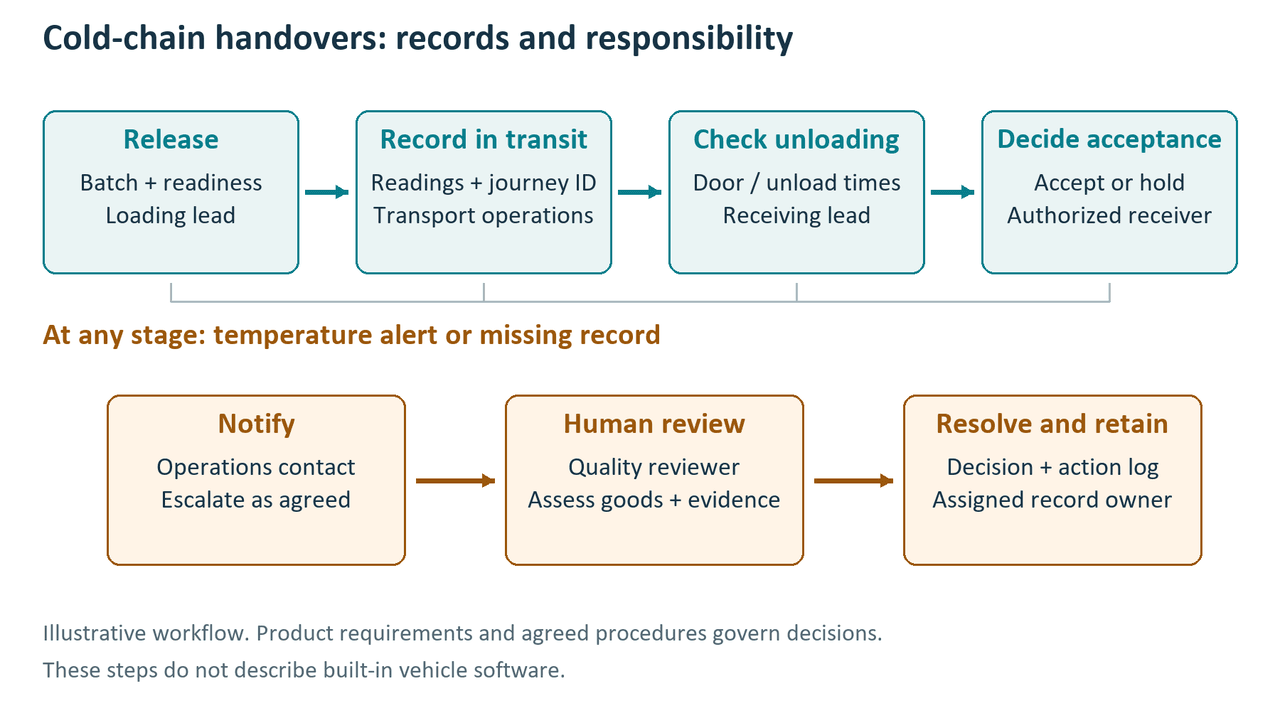
The shipper or loading lead should sign off a departure record identifying the batches, preparation checks and loading completion time. This establishes which goods were released and who confirmed their readiness. In automated delivery, reaching the scheduled departure time does not mean the load is ready. Staff must be able to approve departure after the checks or hold the vehicle if a check fails.
Useful temperature records let the receiver trace a reading back to the goods being accepted. Link the shipment and batch identifiers with the vehicle, recording device and journey times. If batches are loaded or removed at different stops, record the times so each batch is matched to the readings taken while it was on board.
Before service starts, agree sensor placement, calibration checks, recording intervals and clock synchronization. Decide where the original records will be stored and how the receiver can retrieve them. These are integration requirements to verify with providers of autonomous delivery systems and refrigeration equipment; they should never be assumed from a vehicle's connectivity alone.
Consider an illustrative journey carrying two batches of fresh food to separate stores. Each receiver needs a different portion of the record. The first store needs the history up to its unloading event. The second needs the full history up to its own unloading, including the first stop and its door opening. A single screenshot showing the final temperature gives neither store a complete account.
Lost connectivity also needs a defined response. A missing remote update may reflect a communications interruption rather than a refrigeration fault. The procedure should establish whether recording continues locally, how data are recovered and who investigates a gap. An incomplete record and a confirmed temperature excursion require different investigations. The transport operations lead should keep the journey and sensor references with any delay or data-gap report, so the receiver can match the evidence to the shipment.
Suppose the second store is still unloading another delivery when the vehicle arrives. The batch remains on board until staff can receive it. Arrival is followed by several distinct steps: access to the compartment, unloading, transfer into suitable storage and acceptance. The receiving lead should record arrival, door opening and unloading completion, together with any unusual waiting time or observations. The authorized receiver then confirms quantity, condition and the acceptance or hold decision. Keeping these events distinct helps explain a delay that would otherwise disappear inside one delivery timestamp.
The receiving team should compare the shipment identity and available temperature history with the agreed acceptance procedure. Door opening can affect air readings; any change needs to be interpreted alongside its duration, measurement location and product requirements. An alarm needs investigation, and a return to the setpoint does not, by itself, show that the goods can be accepted.
A temperature alert should reach a named operations contact, with a defined escalation route to the authorized food-quality reviewer. Dispatch can arrange a hold, alternative storage or recovery movement under the agreed procedure. Equipment support investigates technical faults. The authorized quality reviewer decides whether the affected goods can be accepted or require further action.
Use one exception record throughout the investigation: shipment and batch IDs; event start and end; readings and sensor identity; door openings or delays; immediate action; reviewer; disposition; and closure time. Record missing evidence explicitly. A shared record lets the next shift continue the investigation without reconstructing it from messages.
Assign responsibility for retaining the original readings, handover records and review decision. The retention period and access arrangements should reflect applicable requirements and customer agreements. Preserve corrections with their author and timestamp so a later reviewer can distinguish the original observation from the final assessment.
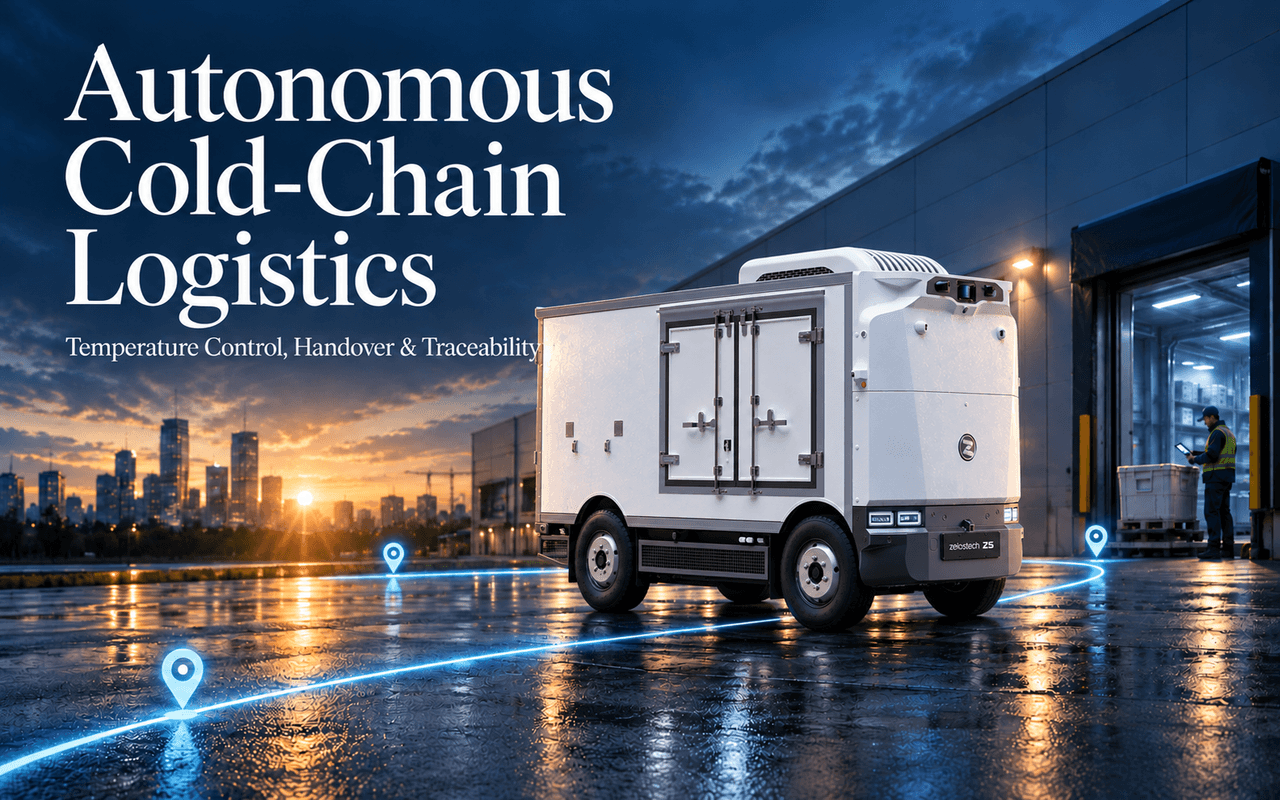
Singapore-based Zelostech's April 2025 DigiTrans deployment announcement places food cold-chain testing alongside loading processes, facility operations and energy management. At DigiTrans's test center in St. Valentin, Austria, the Z5 was undergoing commissioning and reliability testing. The announcement did not report shipment temperatures or receiving decisions; its relevance here is the scope of validation.
For a food distributor, that scope connects three questions: can the vehicle carry the load under the required conditions, can staff transfer it without avoidable exposure, and can the receiver verify its history? Zelostech's Z5 Cold-Chain RoboVan lists a refrigeration range of -20°C to 12°C and applications including fresh produce and dairy. Matching the vehicle to the cargo is the starting point; the handover procedure needs its own acceptance test.
A practical test would use the two-store scenario above. The loading lead releases two identified batches with their preparation records. At the first store, staff record unloading and door closure while the second batch remains aboard. At the second, an agreed receiving delay tests whether cooling, recording and access to the batch history continue through the wait. This is a proposed test for the distributor, separate from the published DigiTrans program.
Before an autonomous cold-chain service goes live, each receiving location should be able to retrieve the correct batch history, verify the required temperature evidence and escalate exceptions through an agreed quality process. The vehicle can automate the journey, but the cold-chain service is only complete when the condition and history of the goods remain verifiable from loading through final acceptance.