Will Your EV Fleet Be Charged Before the Next Shift?

Three vehicles return to the depot with different amounts of energy remaining. Two charging points are available. The first departure is only a few hours away. There may be enough electricity to charge all three overnight, yet one vehicle can still miss its shift if the wrong charging sequence is chosen.
EV fleet charging is a scheduling problem with an energy constraint. The plan needs to match each vehicle's return time, required departure energy and next assignment to the power and charging access actually available.
The worked example below uses hypothetical vehicles and explicit assumptions. It demonstrates the planning method, rather than the charging performance of a particular model or a reported customer operation.
Work backwards from departure energy
Start with the next duty. Estimate energy for driving, auxiliary equipment and the expected operating conditions, then add the operator's agreed reserve. Compare that requirement with usable energy remaining on arrival. The difference is the energy to add to the battery before departure; it is not necessarily the energy needed to reach a full charge.
For warehouse transfer, a short route can repeat many times before the next charging opportunity. Include the full shift, return movements and expected waiting, rather than calculating only the first journey. Use measured consumption from representative duties when available and retain an allowance for uncertainty.
For example, assume a vehicle needs 24 kWh for its next duty and a 6 kWh reserve. If 12 kWh of usable energy remains on arrival, its charging requirement is 18 kWh. These are assumed energy values. Converting a displayed state-of-charge percentage into usable energy requires the vehicle's actual battery information.
Keep energy and power separate. Energy, measured in kWh, describes how much must be added. Power, measured in kW, determines the rate. The useful planning rate is the average net power reaching the battery across the required charging interval, which can differ from the charger's advertised rating.
A three-vehicle charging schedule
Assume two compatible charging points, each drawing a constant 10 kW, with 90% of that energy reaching the battery. Each therefore adds 9 kWh per hour. The depot has 20 kW available for charging after other loads. Assume each vehicle can accept this rate throughout the required interval, with no tapering or temperature derating.
Allow ten minutes to clear a point and connect the next vehicle. Arrival times below mean the vehicles are ready to connect after unloading and checks. The energy requirements are the remaining battery shortfalls, already allowing for the next duty and reserve.
Vehicle | Ready to connect | Next departure | Energy to add | Assigned charging period |
A | 18:00 | 22:00 | 18 kWh | Point 1, 18:00–20:00 |
B | 19:00 | 21:30 | 12 kWh | Point 2, 19:00–20:20 |
C | 20:00 | 23:30 | 24 kWh | Point 1, 20:10–22:50 |
The required charging times are two hours, one hour twenty minutes and two hours forty minutes. Together, the vehicles receive 54 kWh at the battery, requiring 60 kWh from the supply under the assumed efficiency. Simultaneous charging never exceeds the available 20 kW.
All three finish before their departure deadlines. Vehicle C has forty minutes between charging completion and departure, while A and B have longer margins. Those margins must accommodate the departure checks and any delay; they are not additional energy capacity.
What changes when all vehicles return together
Suppose the same vehicles become available at 20:00 instead. Starting A and B first finishes them at 22:00 and 21:20. After the ten-minute changeover, C can start at 21:30 but finishes at 00:10, forty minutes after its departure. The same hardware and total energy requirement now produce a missed assignment.
That result exposes a weakness in this simple, uninterrupted charging sequence. It does not prove that every alternative schedule is impossible. Reallocating power, interrupting sessions or changing assignments would require a new calculation and confirmation that the equipment and operating procedures support it. Each extra vehicle move also consumes staff time and charging access.
Staggered returns use the earlier evening productively. If the delivery schedule can release a vehicle sooner without harming service, charging can begin before the main arrival wave. Where returns cannot move, the planner needs to change another constraint: available power, charging access, required duty or the vehicle assigned to it.
The US Department of Energy's infrastructure guidance recommends coordinating charging requirements and electrical capacity with the utility. This matters when adding charging points: more connectors do not automatically create more site power. Shared capacity can reduce the rate available to each connected vehicle.
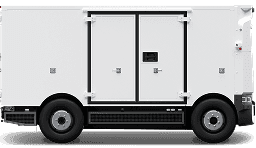
Some duties have no single evening return wave. Pallets and totes moving repeatedly between warehouse floors need a planned release from service before charging can start. That is the scheduling question raised by the CEVA Blue Hub trial in Singapore: Zelostech's September 2026 announcement describes Z10 RoboVans using the facility's existing ramps for inter-floor inventory movements. The trial is a different operating pattern from the depot-return example above.
For this kind of duty, record accumulated work and identify which movements can wait or pass to another vehicle during a charging break. The trial announcement does not disclose energy per shift, charging rates or charger numbers. The illustrative 10 kW rate and 90% efficiency above are calculation assumptions, not reported CEVA operating data.
Decide what happens when a charging window is missed
Recalculate readiness as return estimates and charging progress change. Dispatch should see the expected energy at departure, the remaining charging time and the effect on the next duty. A vehicle being plugged in is insufficient evidence that it will be ready.
Give priority to the departures with the least recoverable margin, while checking the consequences for the rest of the fleet. If C arrives late, moving it ahead of B may simply transfer the missed departure to another customer. Compare the revised schedule before making the change.
A reserve vehicle helps only if it is charged, serviceable and suitable for the load and route. Set a decision time for substitution early enough to transfer the assignment and complete loading. For a charger failure, identify the available alternative and verify its connector, access and power rather than assuming another socket provides equivalent service.
When specifying a Z10 RoboVan for a repeated shuttle duty, ask its Singapore-based supplier, Zelostech, to confirm the charging interface, accepted power and expected charging profile. Confirm separately who connects it and returns it to service. Autonomous driving does not establish automatic charging connection. Those details determine whether a nominal break is a usable charging window.
Make readiness visible to the next shift
EV fleet charging management should bring together confirmed return times, measured energy, charger status and departure commitments. Assign the depot team responsibility for connection and equipment checks, and dispatch responsibility for deciding whether a revised assignment is necessary.
Review expected versus actual charging duration, missed connections, late returns and substitutions. These records help distinguish an energy-estimation problem from a queue or equipment problem. Fixing the cause is more useful than repeatedly adding a larger time allowance.
Reliable electric fleet charging ends with vehicles ready for their next jobs. Assess EV fleet charging infrastructure against that result: the right vehicle, with enough usable energy, released before its departure deadline. Overnight energy totals are useful, but the timetable determines whether the deliveries move.