What Is Smart Transportation? A Guide to IoT, Connected Systems, and Goods Movement
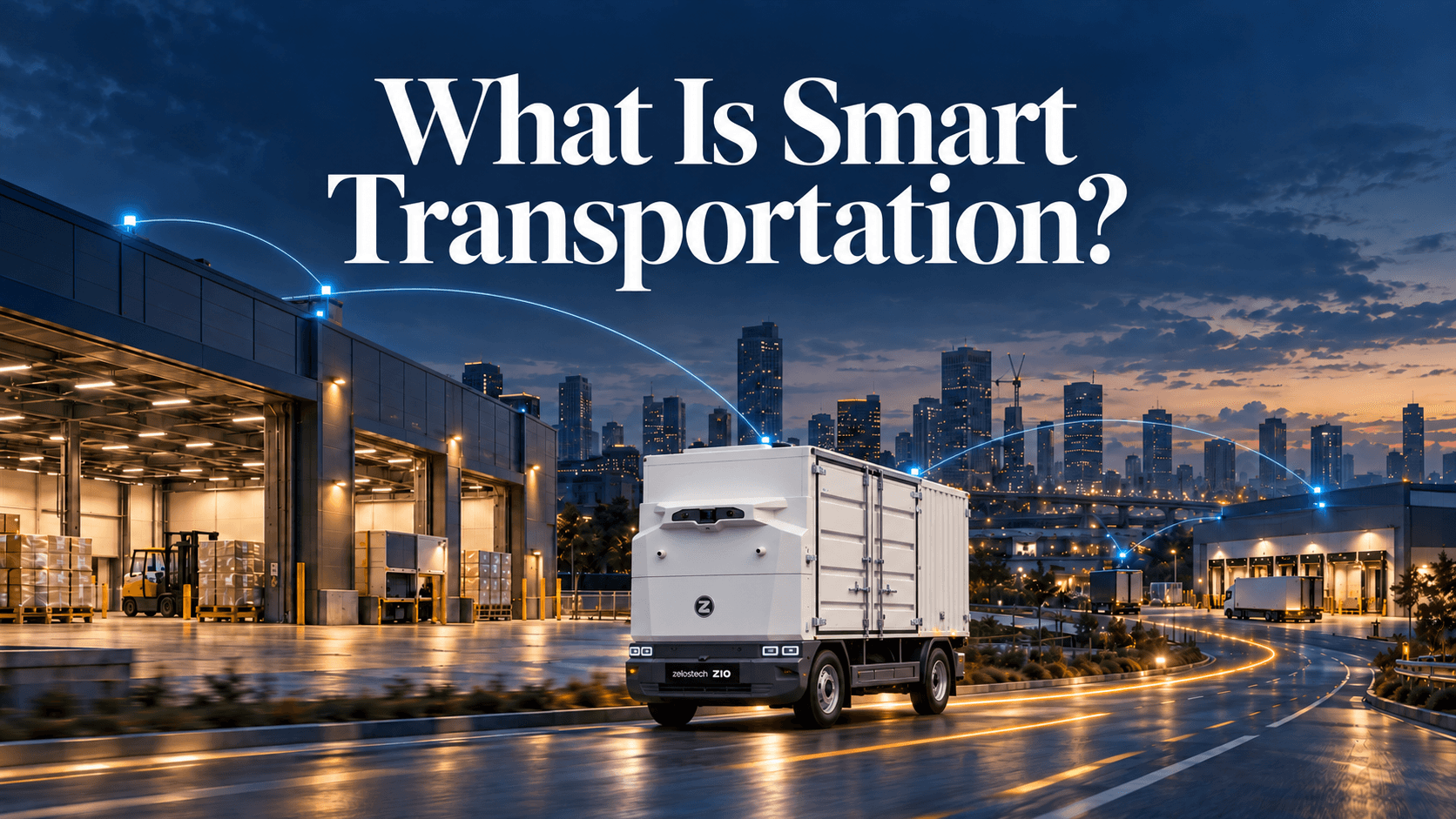
A RoboVan can complete a journey between two distribution centers while several other systems organize the work around it. Warehouse software identifies the goods to move. A fleet platform assigns the transport task. Vehicle equipment reports progress, and the receiving facility confirms delivery. Each contributes to the service, but each has a different responsibility.
Understanding these relationships helps explain where an autonomous logistics vehicle fits within smart transportation. The vehicle performs a defined transport task inside a wider network of information, infrastructure and services.
What smart transportation means and what it covers
Smart transportation uses sensing, communications and software to improve how people and goods move. Its scope includes traffic management, public transport coordination and freight operations. The US Department of Transportation describes intelligent transportation systems as integrating technologies and systemwide planning to improve transport efficiency and operations.
For logistics, the relevant connections extend beyond the road. Vehicle availability, shipment readiness and receiving capacity influence whether a delivery can proceed. Traffic information may explain a late arrival, while warehouse information determines whether the goods are ready to leave.
Smart transportation systems bring such information into the decisions that organize movement. They can support conventional vehicles, autonomous vehicles or both. A distribution network can become better coordinated without automating driving, and an autonomous vehicle still needs to fit the network's dispatch and receiving arrangements.
Four layers of smart transportation
A useful way to explain smart transportation technology is through four layers: sensing, communication, platforms and services. This is a simplified reference model. Actual systems may combine functions or distribute them across several organizations.
Sensing → Communication → Platforms → Transport services
Information moves continuously between these layers. Sensors provide operating data, communication systems carry it, platforms use it to coordinate tasks, and transport services turn those decisions into physical movement.
Sensing establishes physical conditions
Sensors and vehicle equipment provide observations such as position, battery status or loading-bay occupancy. Roadside equipment can supply traffic observations where available. Each observation needs context: what was measured, where it came from and when it was recorded.
Business events have a different origin. A warehouse system confirming that picking is complete reports the progress of work, rather than a direct sensor measurement. Platforms may use both types of information, but should preserve the distinction.
Communication carries information between systems
Communication links let equipment and software exchange selected data. An Internet of Things (IoT) connection can carry a sensor reading to an operational platform. A software interface can pass a shipment-ready event between warehouse and transport systems.
Reliable exchange requires agreed identifiers and message meanings. Systems also need to recognize missing or outdated information. A bay sensor may report only when occupancy changes, so an older timestamp alone does not establish that its reading is wrong.
Platforms coordinate resources and tasks
Platforms combine information to support operational decisions. Warehouse management software tracks goods and preparation; transport management software organizes shipments; fleet software assigns and monitors vehicle tasks.
These systems need not become one central platform. They need enough shared information to coordinate the work. Knowing that goods are ready and that a vehicle is available can support dispatch, provided the destination can receive the load.
Services turn coordination into goods movement
The service layer describes the application delivered to users, such as a scheduled warehouse transfer or retail replenishment run. It connects the supporting technology with the promised transport outcome.
A RoboVan participates by moving goods on a suitable route. Loading, unloading and receipt may involve other equipment and people. Completion records then feed back into the relevant business systems, allowing the next activity to proceed.
These layers describe functions, not separate pieces of equipment. A RoboVan can incorporate sensing, connectivity and onboard computing while delivering a transport service. Its driving system controls the vehicle locally, while fleet and business platforms coordinate work across the wider operation.
How IoT connectivity differs from autonomous driving decisions
IoT connects physical devices so they can share observations or status information. Autonomous driving interprets the driving environment and controls vehicle motion within specified operating conditions. Receiving a transport instruction and deciding how to pass a junction are different tasks.
For example, a fleet platform may assign a destination to a vehicle. The onboard driving system handles the acceleration, steering and braking required to move there. A loading-bay occupancy message can inform an arrival plan; it does not establish that the road ahead is clear.
Operational connectivity and driving control must also be considered separately when communication is interrupted. A deployment needs defined responses for both vehicle safety and service continuity. Losing an arrival update and losing a connection required by the approved operating arrangement may have different consequences.
Remote supervision follows the project's approved procedures. It should not be confused with routine task assignment or assumed to mean that a remote operator continuously drives the vehicle.
How data moves through a goods transport task
Consider a recurring transfer between two distribution facilities. The following is an illustrative integration pattern, with responsibilities that may be allocated differently in an actual project.
Origin warehouse system → Transport or fleet platform → Vehicle → Receiving system → Order status update
The origin warehouse sends a shipment-ready event identifying the goods and collection point. The transport or fleet platform associates that shipment with a vehicle task and destination. The vehicle returns progress information, which can support an updated arrival estimate for the receiving facility.
At the destination, vehicle arrival establishes location. The receiving process separately confirms that goods have been accepted and updates the shipment record. A shared shipment or task reference allows the systems to connect these events without treating arrival as completed receipt.
Information may also move back through the chain. If the receiving area becomes unavailable, the facility can notify the coordinating platform. Dispatch can then arrange an authorized response, while any changed vehicle movement remains within permitted operating conditions.
How FairPrice uses RoboVans within its distribution network
Singapore-based Zelostech's work with FairPrice illustrates autonomous transport within an established logistics network. Its Singapore operations announcement describes Z10 RoboVans transporting palletized goods within and between distribution centers at Benoi, Joo Koon and Sunview Road, on routes of up to 5.5 km.
The service is the transfer of goods between facilities. The RoboVan automates the driving needed for that movement, while dispatch, cargo preparation and receiving remain distinct responsibilities. This places vehicle automation within the complete shipment process.
Zelostech's RoboVan technology overview describes onboard perception and driving decisions alongside centralized fleet visibility. The vehicle therefore spans several functions in the four-layer model. The illustrative data flow above explains the coordination needs; applying it would require defining the project's actual warehouse and fleet interfaces.
An April 2026 operations update identifies Zelostech as Singapore's first RoboVan company to obtain a public-road testing permit for autonomous logistics vehicles, in June 2024. FairPrice operations began under supervision in October 2024, with remotely supervised driverless public-road supply-chain operations approved in October 2025. The updates document more than a year of real logistics experience.
The April update also reports that the deployment enabled drivers to move to higher-value delivery roles. This is a practical outcome of assigning recurring transport work to autonomous vehicles while retaining people for other delivery tasks.
How the three concepts compare
Concept | Scope and responsibility | Goods transport example |
Smart transportation | Coordinates movement across transport systems and services | Align shipment readiness, vehicle availability and receiving capacity. |
Connected vehicle | Exchanges information with other systems | Report position and receive an assigned transport task. |
Autonomous driving | Performs driving functions within specified operating conditions | Control vehicle motion along a suitable logistics route. |
Understanding the vehicle's place in the system
Smart transportation brings together sensing, communication, platforms and services to organize movement. IoT connections make physical conditions visible to other systems, platforms coordinate transport work, and autonomous driving controls vehicle motion within defined operating conditions.
For logistics operators, this distinction clarifies the role of a RoboVan. It can automate driving for a particular transport task, while surrounding systems and teams prepare the goods, assign the work and confirm delivery. Assessing how these responsibilities connect helps determine whether an autonomous vehicle can support the complete logistics service.